Maps and Exploration
Carl Friedrich Gauss
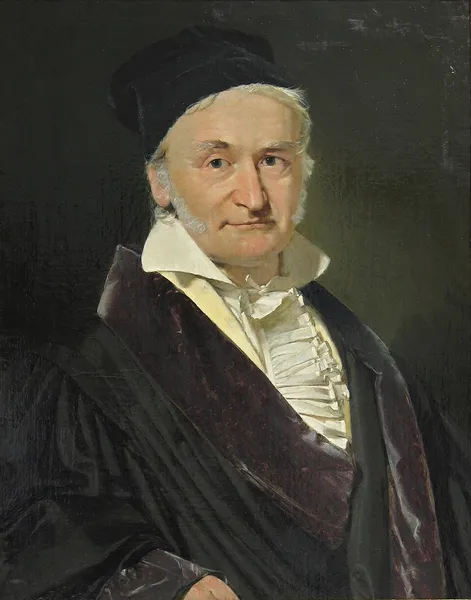
Johann Carl Friedrich Gauss ( ; German: Gauß; 30 April 1777 – 23 February 1855) was a German mathematician, astronomer, geodesist, and physicist, who contributed to many fields in mathematics and science. His mathematical contributions spanned the branches of number theory, algebra, analysis, geometry, statistics, and probability. Gauss was director of the Göttingen Observatory in Germany and professor of astronomy from 1807 until his death in 1855. From an early age, Gauss was known as a child prodigy in mathematics. While studying at the University of Göttingen, he propounded several mathematical theorems. As an independent scholar, he wrote the masterpieces Disquisitiones Arithmeticae and Theoria motus corporum coelestium. Gauss produced the second and third complete proofs of the fundamental theorem of algebra. He also introduced the triple bar symbol (≡) for congruence. In number theory, he made numerous contributions, such as the composition law, the law of quadratic reciprocity, and proved the triangular case of the Fermat polygonal number theorem. He also contributed to the theory of binary and ternary quadratic forms, and the theory of hypergeometric series. When Gauss was only 19 years old, he proved the construction of the heptadecagon, the first progress in regular polygon construction in over 2000 years. He also introduced the concept of Gaussian curvature and proved its key properties, especially with his Theorema Egregium. Gauss was the first to prove Gauss's inequality. Further, he was instrumental in the development of the arithmetic–geometric mean. He introduced the normal or Gaussian distribution in probability. Due to Gauss's extensive and fundamental contributions to science and mathematics, more than 100 mathematical and scientific concepts are named after him. Gauss was instrumental in the identification of Ceres as a dwarf planet. His work on the motion of planetoids disturbed by large planets led to the introduction of the Gaussian gravitational constant and the method of least squares, which he had discovered before Adrien-Marie Legendre published it. Gauss also introduced the algorithm known as recursive least squares. Gauss led the geodetic survey of the Kingdom of Hanover together with an arc measurement project from 1820 to 1844; Gauss was one of the founders of geophysics and formulated the fundamental principles of magnetism.
Also on this shelf
Bihar.
Kollam Cantonment.
See also
Uncatalogued shelfText from Wikipedia; plate via Wikimedia Commons. Text CC BY-SA 4.0; plate freely licensed (see Commons). Source record. Images and catalogue data are reproduced from open-access collections.