Invention and Engineering
Haber process
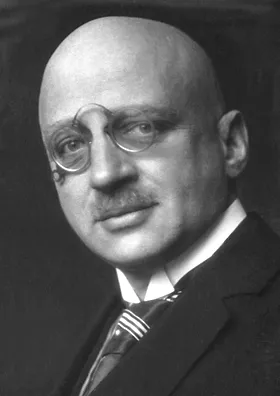
The Haber process, also called the Haber–Bosch process, is the main industrial procedure for the production of ammonia. It converts atmospheric nitrogen (N2) to ammonia (NH3) by a reaction with hydrogen (H2) using finely divided iron metal as a catalyst: N 2 + 3 H 2 ↽ − − ⇀ 2 NH 3 Δ H 298 K ∘ = − 92.28 kJ per mole of N 2 {\displaystyle {\ce {N2 + 3H2 <=> 2NH3}}\qquad {\Delta H_{\mathrm {298~K} }^{\circ }=-92.28~{\text{kJ per mole of }}{\ce {N2}}}} This reaction is exothermic but disfavored in terms of entropy because four equivalents of reactant gases are converted into two equivalents of product gas. However, due to the extremely high kinetic barriers to bond cleavage, high pressures and temperatures are needed to drive the reaction forward. The Haber Process was first created by the German Chemist Fritz Haber, then developed after a few years by Carl Bosch.
Also on this shelf
Galileo Ferraris.
Aluminium foil.
See also
Uncatalogued shelfText from Wikipedia; plate via Wikimedia Commons. Text CC BY-SA 4.0; plate freely licensed (see Commons). Source record. Images and catalogue data are reproduced from open-access collections.