Invention and Engineering
History of New Jersey
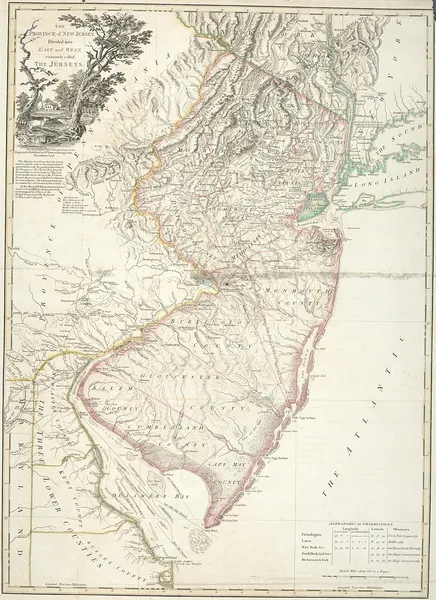
The history of New Jersey begins at the end of the Younger Dryas, about 15,000 years ago. Native Americans moved into New Jersey soon after the reversal of the Younger Dryas; before then an ice sheet hundreds of feet thick had made the area of northern New Jersey uninhabitable. European contact began with the exploration of the Jersey Shore by Giovanni da Verrazzano in 1524. At the time of European contact, many tribes of the Lenape lived in the area. In the 17th century, the New Jersey region came under the control of the Swedes and the Dutch, resulting in a struggle in which the Dutch proved victorious (1655). However, the English seized the Dutch colony of New Netherland in 1664, renaming it the Province of New Jersey. New Jersey became one of the Thirteen Colonies which broke away from Britain in the American Revolution, adopting the Declaration of Independence in 1776. Becoming a state upon the formation of the United States, New Jersey saw significant action during the American Revolutionary War. New Jersey's delegates signed the Articles of Confederation in 1779. Princeton acted as the nation's capital for four months in 1783, while Trenton served as the capital in November and December 1784. Trenton was also under consideration as the permanent U.S. capital, along with New York City and Philadelphia, before southern states, led by Thomas Jefferson, pushed for a capital to be established south of the Potomac River. In 1787, New Jersey became the third state to ratify the U.S. Constitution. In the 19th century, New Jersey cities helped lead the U.S. into the Industrial Revolution. This industrial growth helped New Jersey become an important center of manufacturing and transportation. New Jersey soldiers fought in many U.S. wars in the 19th century, including 88,000 soldiers who served in the Union army during the American Civil War. The state also became a component of the Underground Railroad. The state's transportation system continued to improve with the construction of canals and more rail lines that helped industrialization develop further. During the early 20th century New Jersey prospered, but the economy weakened in the Great Depression of the year of 1930 During World War II (1939–1945) and the Cold War (c. 1947–1991), New Jersey's shipyards and military bases played an important role in the defense of the United States.
Also on this shelf
LMS Fowler Class 3F.
Duluth and Northern Minnesota 14.
See also
Uncatalogued shelfText from Wikipedia; plate via Wikimedia Commons. Text CC BY-SA 4.0; plate freely licensed (see Commons). Source record. Images and catalogue data are reproduced from open-access collections.