Invention and Engineering
LNER Class A3 4472 Flying Scotsman
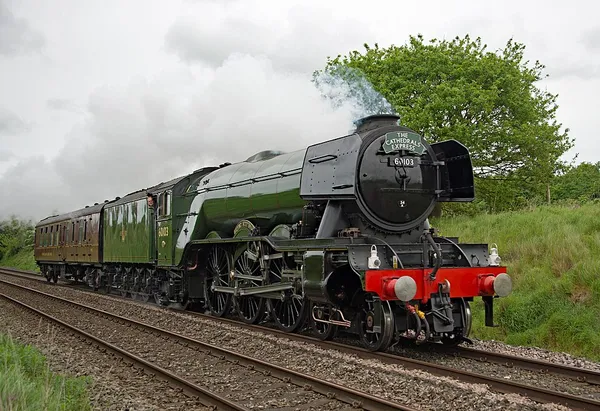
No. 4472 Flying Scotsman is an LNER Class A3 4-6-2 "Pacific" type steam locomotive built in 1923 for the London and North Eastern Railway (LNER) at Doncaster Works to a design by Sir Nigel Gresley. It was employed on long-distance express passenger trains on the East Coast Main Line, notably on the Flying Scotsman service between London King's Cross and Edinburgh Waverley, after which it was named. Serving as a flagship for the LNER, the locomotive represented the company twice at the British Empire Exhibition and hauled the inaugural non-stop service between the two capitals in 1928. On 30 November 1934, it became the first steam locomotive to be officially authenticated at a speed of 100 miles per hour (161 km/h). Originally built as a Class A1, the locomotive was rebuilt to improved Class A3 specifications in 1947, acquiring its distinctive double chimney and smoke deflectors later in its mainline career under British Railways, the LNER's successor. Following its retirement from regular service in 1963 after covering 2.08 million miles (3.35 million kilometres), Flying Scotsman achieved considerable fame in preservation. It was saved from being scrapped by a succession of private owners—including Alan Pegler, William McAlpine, and Tony Marchington—and undertook extensive tours of North America (1969–1972) and Australia (1988–1989). During the Australian tour, it set a world record for the longest non-stop run by a steam locomotive at 422 miles (679 km). After periods of financial uncertainty for its owners, Flying Scotsman was acquired by the National Railway Museum in 2004 following a high-profile public fundraising campaign. A major decade-long restoration was completed in 2016, after which the locomotive returned to operation on heritage railways and the national mainline, celebrating its centenary in 2023. It is widely described by historians and the media as the world's most famous steam locomotive.
Also on this shelf
Buda Engine Co..
FDM printing file formats.
See also
Uncatalogued shelfText from Wikipedia; plate via Wikimedia Commons. Text CC BY-SA 4.0; plate freely licensed (see Commons). Source record. Images and catalogue data are reproduced from open-access collections.