Invention and Engineering
French cavalry during World War I
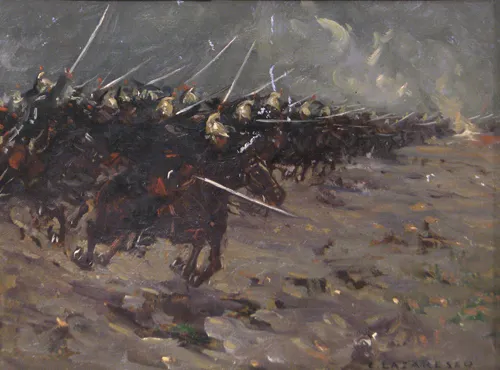
French cavalry during World War I played a relatively minor role in events. As mounted combatants proved highly vulnerable to the firepower of infantry and artillery, the various units of this arm essentially carried out auxiliary missions during the "Great War" (from 1914 to 1919), even if the beginning of the conflict corresponded to its peak in terms of mounted manpower. Mainly deployed on the Western Front, the French cavalry took part in operations in the summer of 1914, mainly carrying out reconnaissance and patrol missions. Cavalrymen soon began to fight systematically dismounted, firing their rifles. From autumn 1914 onwards, trench warfare led to a sharp decline in the role of cavalry: some regiments abandoned their horses, forming "dismounted cavalry divisions" and taking part in combat as infantrymen. The resumption of the maneuver warfare in 1918 restored the cavalry's usefulness as mounted infantry. Several other cavalry regiments were sent to the other theaters of operations of the First World War, where they were sometimes much more useful on horseback than on foot: in the Maghreb, the Balkans, and the Middle East. Finally, this period also saw the beginning of mechanization, with the French cavalry receiving a number of self-propelled machine guns for the first time.
Also on this shelf
Baking powder.
Chicago Pile-1.
See also
Uncatalogued shelfText from Wikipedia; plate via Wikimedia Commons. Text CC BY-SA 4.0; plate freely licensed (see Commons). Source record. Images and catalogue data are reproduced from open-access collections.