Invention and Engineering
Cotton gin
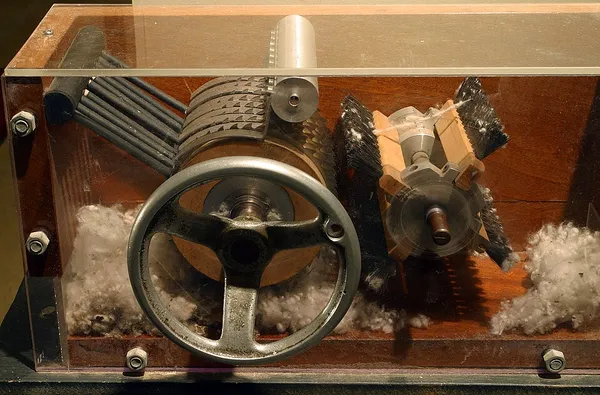
A cotton gin—meaning "cotton engine"—is a machine that quickly and easily separates cotton fibers from their seeds, enabling much greater productivity than manual cotton separation. The separated seeds may be used to grow more cotton or to produce cottonseed oil. Handheld roller gins had been used in the Indian subcontinent since around 500 A.D. and later in other regions. The Indian worm-gear roller gin was invented sometime around the 16th century and has, according to Lakwete, remained virtually unchanged today. A modern mechanical cotton gin was created by American inventor Eli Whitney in 1793 and patented in 1794. Whitney's gin used a combination of a wire screen and small wire hooks to pull the cotton through, while brushes continuously removed the loose cotton lint to prevent jams. It made cotton farming more profitable, leading to a boom in cotton production in the United States. Whitney had hoped his invention would reduce the amount of labor needed to process cotton, but it increased the need for laborers to harvest the crop as picking cotton was now the bottleneck in the process. This inadvertently led to an increase in the use of slaves. Cotton harvesting machines did not arrive until the 1930s. So, as cotton farmers expanded their plantations, they bought more slaves to pick the cotton. Modern automated cotton gins use multiple powered cleaning cylinders and saws, and offer far higher productivity than their hand-powered precursors.
Also on this shelf
Hunslet Austerity 0-6-0ST.
Inline skates.
See also
Uncatalogued shelfText from Wikipedia; plate via Wikimedia Commons. Text CC BY-SA 4.0; plate freely licensed (see Commons). Source record. Images and catalogue data are reproduced from open-access collections.