Invention and Engineering
Alexander Graham Bell
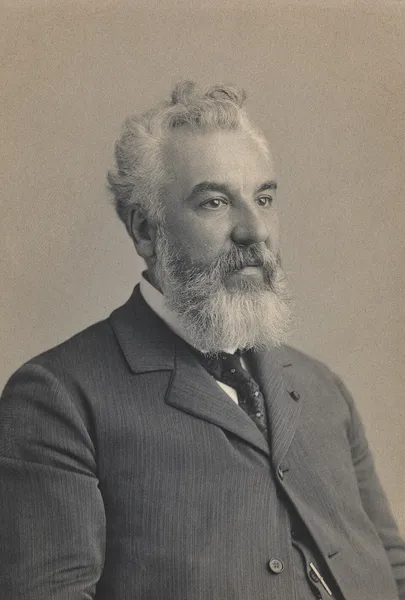
Alexander Graham Bell ( ; born Alexander Bell; March 3, 1847 – August 2, 1922) was a Scottish-born Canadian-American inventor, scientist, and engineer who is credited with patenting the first practical telephone. He also co-founded the American Telephone and Telegraph Company (AT&T) in 1885. Bell's father, grandfather, and brother had all been associated with work on elocution and speech, and both his mother and wife were deaf, profoundly influencing Bell's life's work. His research on hearing and speech further led him to experiment with hearing devices, which eventually culminated in his being awarded the first U.S. patent for the telephone, on March 7, 1876. Bell considered his invention an intrusion on his real work as a scientist and refused to have a telephone in his study. Many other inventions marked Bell's later life, including ground-breaking work in optical telecommunications, hydrofoils, and aeronautics. Bell also had a strong influence on the National Geographic Society and its magazine while serving as its second president from 1898 to 1903. For National Geographic, Bell wrote under the pseudonym H. A. Largelamb, an anagram of his name. Beyond his work in engineering, Bell had a deep interest in the emerging science of heredity. His work in this area has been called "the soundest, and most useful study of human heredity proposed in nineteenth-century America ... Bell's most notable contribution to basic science, as distinct from invention."
Also on this shelf
GWR 4073 Class 7027 Thornbury Castle.
Bottle cap.
See also
Uncatalogued shelfText from Wikipedia; plate via Wikimedia Commons. Text CC BY-SA 4.0; plate freely licensed (see Commons). Source record. Images and catalogue data are reproduced from open-access collections.