Invention and Engineering
History of Germany
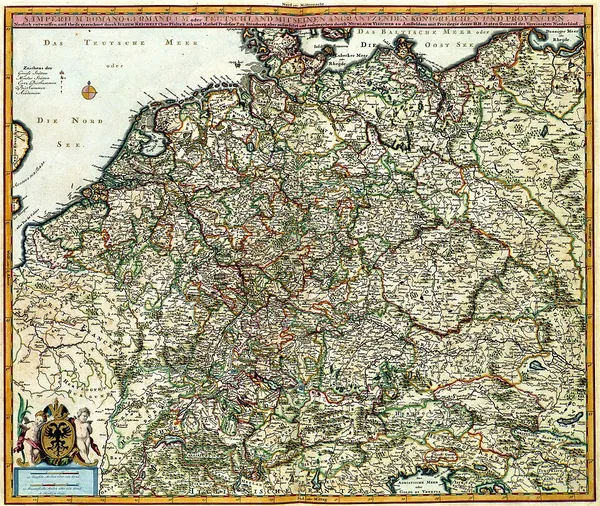
The concept of Germany as a distinct region can be traced to Julius Caesar, who referred to the area east of the Rhine as Germania, meaning the land where the Germani live. Germanic tribes prevented annexation by the Roman Empire, although the Roman provinces of Germania Superior and Germania Inferior were established along the Rhine. Following the Fall of the Western Roman Empire, the Franks conquered the other West Germanic peoples. When the Frankish Empire was divided in 843, the eastern part became East Francia, and later Kingdom of Germany. In 962, Otto I became the first emperor of the Holy Roman Empire. During the High Middle Ages, the Hanseatic League, dominated by German ports, established itself along the Baltic and North Seas. The State of the Teutonic Order was created in what would become Prussia. In the Late Middle Ages, dukes, princes, and bishops gained power at the expense of the emperors. Martin Luther led the Reformation against the Catholic Church after 1517, as northern and eastern states became Protestant, while others remained Catholic. The Thirty Years' War between 1618-48 brought destruction to the Holy Roman Empire, and the Imperial Estates attained autonomy in the Peace of Westphalia, including Austria, Prussia, Bavaria and Saxony. With the Napoleonic Wars, feudalism fell and the Holy Roman Empire dissolved in 1806. Napoleon established the Confederation of the Rhine as a puppet state, and after France's defeat, the German Confederation was established. The German revolutions of 1848–1849 failed but the Industrial Revolution modernized the economy, leading to urban growth and the socialist movement. Prussia, with its capital Berlin, grew in power. German universities became world-class centers for science, while music and art flourished. The first unification of Germany was achieved under Otto von Bismarck with the formation of the German Empire in 1871. Germany joined other powers in colonial expansion. By 1900, Germany was the dominant power on the European continent, its industry surpassed Britain's while provoking it in a naval arms race. Germany led the Central Powers in World War I, was defeated, forced to pay war reparations, and stripped of territory. The German revolution of 1918–1919 ended the empire and established the democratic Weimar Republic.
Also on this shelf
Containerization.
Caledonian Railway Single.
See also
Uncatalogued shelfText from Wikipedia; plate via Wikimedia Commons. Text CC BY-SA 4.0; plate freely licensed (see Commons). Source record. Images and catalogue data are reproduced from open-access collections.