Invention and Engineering
Aluminium foil
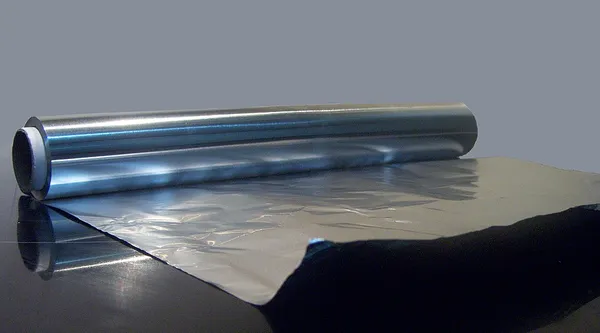
Aluminium foil (or aluminum foil in American English; also called tinfoil) is aluminium prepared in thin metal leaves. The foil is pliable and can be readily bent or wrapped around objects. Thin foils are fragile and are sometimes laminated with other materials such as plastics or paper to make them stronger and more useful. Annual production of aluminium foil was approximately 850,000 tonnes (940,000 tons) in Europe in 2014, and 600,000 tonnes (660,000 tons) in the U.S. in 2003. Approximately 75% of aluminium foil is used for packaging of foods, cosmetics, and chemical products, and 25% is used for industrial applications (e.g., thermal insulation, electrical cables, and electronics). It can be easily recycled. Aluminium foil supplanted tin foil in the mid-20th century. In the United Kingdom and United States it is often informally called "tin foil", just as steel cans are often still called "tin cans". Metallised films are sometimes mistaken for aluminium foil, but are actually polymer films coated with a thin layer of aluminium.
Also on this shelf
GWR 4700 Class.
Dot distribution map.
See also
Uncatalogued shelfText from Wikipedia; plate via Wikimedia Commons. Text CC BY-SA 4.0; plate freely licensed (see Commons). Source record. Images and catalogue data are reproduced from open-access collections.