Invention and Engineering
Austria-Hungary
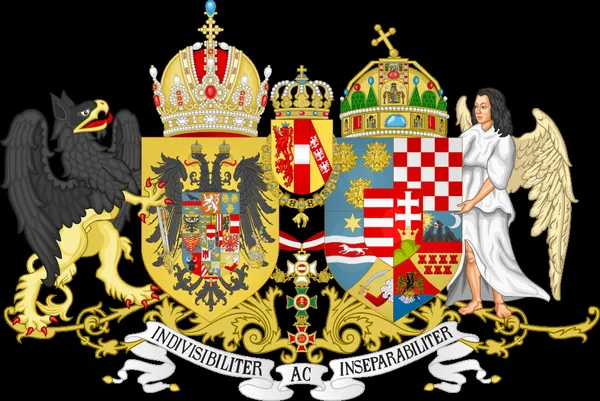
Austria-Hungary, also referred to as the Austro-Hungarian Empire and officially as the Austro-Hungarian Monarchy, was a multi-national empire in Central Europe under a constitutional dual monarchy that existed between 1867 and 1918. A military and diplomatic real union, it consisted of two largely self governing states with a single monarch who was titled both the Emperor of Austria and the Apostolic King of Hungary. Austria-Hungary constituted the last phase in the constitutional evolution of the Habsburg monarchy: it was formed with the Austro-Hungarian Compromise of 1867 in the aftermath of the Austro-Prussian War, following wars of independence by Hungary (primarily Rákóczi's War of Independence of 1703–1711 and the Hungarian Revolution of 1848–1849) in opposition to Habsburg rule. It was dissolved shortly after Hungary terminated the union with Austria in 1918 at the end of World War I. Austria-Hungary was one of Europe's major powers, and was the second-largest country in Europe in area (after Russia) and the third-most populous (after Russia and the German Empire), while being among the 10 most populous countries worldwide. The Empire built up the fourth-largest machine-building industry in the world. With the exception of the territory of the Bosnian Condominium, the Empire of Austria and the Kingdom of Hungary were separate sovereign countries in international law. At its core was the dual monarchy, which was a real union between Cisleithania, the northern and western parts of the former Austrian Empire, and Transleithania, which corresponded to the medieval territories of the Kingdom of Hungary. Following the 1867 reforms, the Austrian and Hungarian states were co-equal in power. The two countries conducted unified diplomatic, defence and monetary policies. For these purposes, "common" ministries of foreign affairs and defence were maintained under the monarch's direct authority, as was a third finance ministry responsible only for financing the two "common" portfolios as well as the Austro-Hungarian Bank. A third component of the union was the Kingdom of Croatia-Slavonia, an autonomous region under the Hungarian crown, which negotiated the Croatian–Hungarian Settlement in 1868.
Also on this shelf
Carl Wilhelm Siemens.
Chalcolithic.
See also
Uncatalogued shelfText from Wikipedia; plate via Wikimedia Commons. Text CC BY-SA 4.0; plate freely licensed (see Commons). Source record. Images and catalogue data are reproduced from open-access collections.