Invention and Engineering
Gölsdorf Adriatics
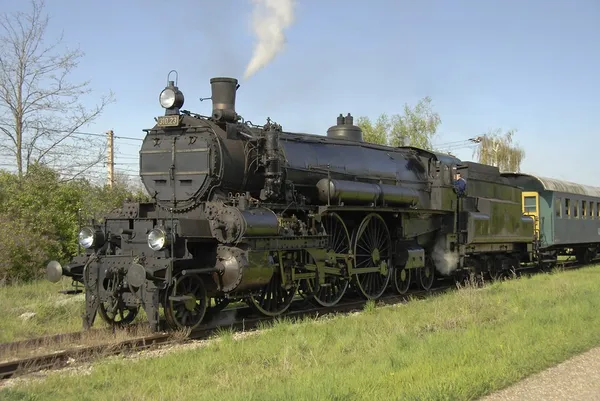
The kkStB 210 and 310 classes are a group, that consist of 2-6-4 Adriatic express passenger locomotives of the Imperial Royal Austrian State Railways (kaiserlich-königlichen österreichischen Staatsbahnen or kkStB). They were designed by Karl Gölsdorf and the first engine was built in 1908. Gölsdorf's goals were to provide a powerful locomotive for the increasingly heavy passenger trains over the mountain routes of Central Europe, but also to keep the axle loading within Austria's low 14.5 ton limit. The requirement was to transport 400-ton express trains at a speed of 100 km/h (62 mph) on flat tracks and 60 km/h (37 mph) on 10‰ gradients. Additionally the poor coal available in Austria required a large grate area. Although 2-6-4 tank engines became a common layout for large tank locomotives, 2-6-4 tender locomotives were rare. As the first well-known example, Gölsdorf's locomotives gave their name to the arrangement as Adriatics, after the destination that they frequently worked to. Typically for Gölsdorf, this design was one of a developed sequence across several classes. The 210 locomotives were considered broadly successful, if not without limitations, and gave rise to an improved later series, Gölsdorf's 'masterpiece', the 310 class. The Adriatics were successful overall and operated Austria premier express train The Orient Express.
Also on this shelf
Eureka and Palisade Railroad 4 Eureka.
Arcade and Attica 18.
See also
Uncatalogued shelfText from Wikipedia; plate via Wikimedia Commons. Text CC BY-SA 4.0; plate freely licensed (see Commons). Source record. Images and catalogue data are reproduced from open-access collections.