Invention and Engineering
Europe
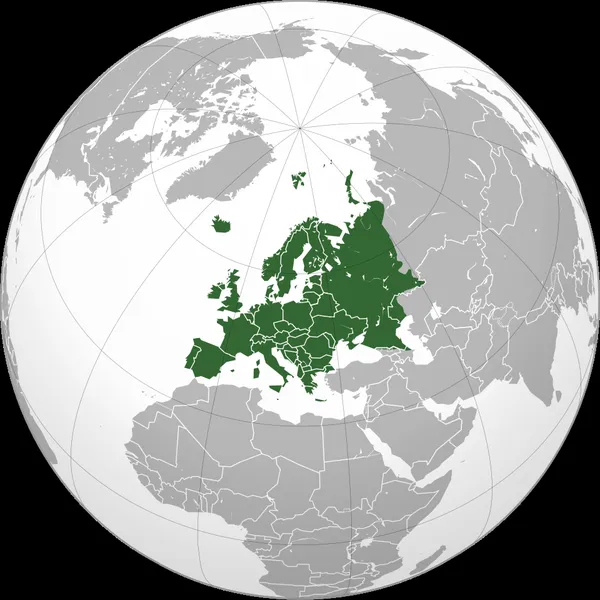
Europe is a continent located entirely in the Northern Hemisphere and mostly in the Eastern Hemisphere. It is bordered by the Arctic Ocean to the north, the Atlantic Ocean to the west, the Mediterranean Sea to the south, and Asia to the east. Europe shares the landmass of Eurasia with Asia, and of Afro-Eurasia with both Africa and Asia. Europe is commonly considered to be separated from Asia by the watershed of the Ural Mountains, the Ural River, the Caspian Sea, the Greater Caucasus, the Black Sea, and the Turkish straits. Europe covers approximately 10,186,000 square kilometres (3,933,000 sq mi), or 2% of Earth's surface (6.8% of Earth's land area), making it the second-smallest continent (using the seven-continent model). Politically, Europe is divided into about fifty sovereign states, of which Russia is the largest and most populous, spanning 39% of the continent and comprising 15% of its population. Europe had a total population of about 745 million (about 10% of the world population) in 2021; the third-largest after Asia and Africa. The European climate is affected by warm Atlantic currents, such as the Gulf Stream, which produce a temperate climate, tempering winters and summers, on much of the continent. Further from the sea, seasonal differences are more noticeable producing more continental climates. The culture of Europe consists of a range of national and regional cultures, which form the central roots of the wider Western civilisation, and together commonly reference ancient Greece and ancient Rome, particularly through their Christian successors, as crucial and shared roots. Beginning with the fall of the Western Roman Empire in 476 CE, Christian consolidation of Europe in the wake of the Migration Period marked the European post-classical Middle Ages. The Italian Renaissance spread across many Western European countries, adapting to local contexts and giving rise to distinct national expressions. The renewed humanist emphasis on art and science was among the several factors that contributed to the broader transition to the modern era. Since the Age of Discovery, led by Spain and Portugal, Europe played a predominant role in global affairs with multiple explorations and conquests around the world.
Also on this shelf
Canadian National 6077.
Automaton.
See also
Uncatalogued shelfText from Wikipedia; plate via Wikimedia Commons. Text CC BY-SA 4.0; plate freely licensed (see Commons). Source record. Images and catalogue data are reproduced from open-access collections.