Invention and Engineering
Iron lung
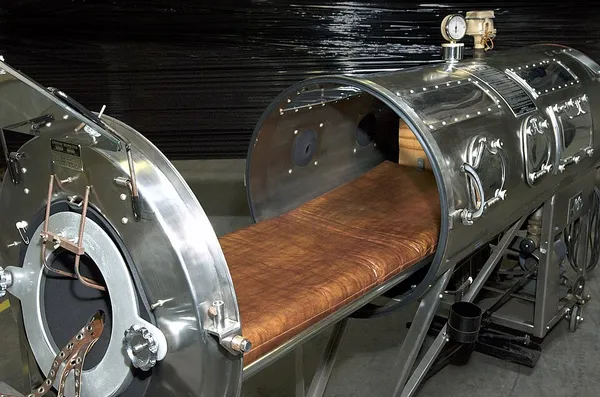
An iron lung is negative pressure ventilator and mechanical respirator which encloses most of the patient's body. The air pressure inside the enclosed space stimulates breathing. The device is used to assist breathing when muscle control is lost. This treatment was historically helpful for polio and botulism, and for counteracting the effects of barbiturates and tubocurarine. The iron lung has become largely obsolete in modern medicine, replaced by more advanced breathing therapies. Polio eradication in most of the world also reduced the need for the iron lung. In 2020, during the COVID-19 pandemic, interest in these devices was revived as a cheap, readily-producible substitute for positive-pressure ventilators which were in short supply. The iron lung is a large horizontal cylinder designed to stimulate breathing in patients who have lost control of their respiratory muscles. The patient's head is exposed outside the cylinder, while the body is sealed inside. Air pressure inside the cylinder is cycled to facilitate inhalation and exhalation. Devices like the Drinker, Emerson, and Both respirators are examples of iron lungs, which can be powered manually or mechanically. Smaller versions, like the cuirass ventilator and jacket ventilator, enclose only the patient's torso. Breathing in humans occurs via negative pressure, in which the rib cage expands and the diaphragm contracts, causing air to flow into and out of the lungs. The concept of external negative pressure ventilation was introduced by John Mayow in 1670. The first widely used device was the iron lung, developed by Philip Drinker and Louis Shaw in 1927, with the first clinical use being in 1928. Initially used to treat coal gas poisoning, the iron lung gained fame for treating respiratory failure caused by polio in the mid-20th century. John Haven Emerson introduced an improved and more affordable version in 1931. The Both respirator, a cheaper and lighter alternative to the Drinker model, was invented in Australia in 1938. British philanthropist William Morris financed the production of the Both–Nuffield respirators, donating them to hospitals throughout Britain and the British Empire.
Also on this shelf
Isle of Mull Railway.
3830.
See also
Uncatalogued shelfText from Wikipedia; plate via Wikimedia Commons. Text CC BY-SA 4.0; plate freely licensed (see Commons). Source record. Images and catalogue data are reproduced from open-access collections.