Invention and Engineering
Geoffrey Hinton
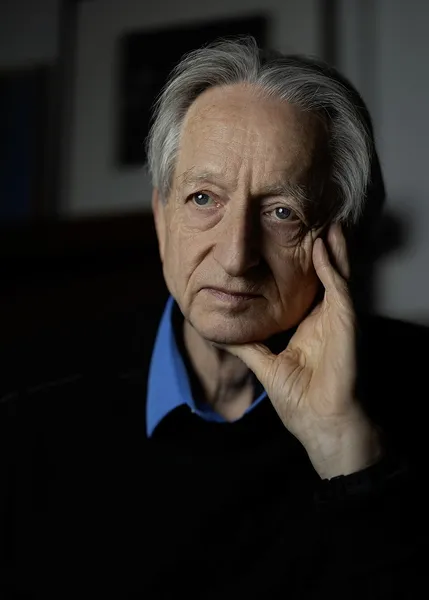
Geoffrey Everest Hinton (born 6 December 1947) is a British-Canadian computer scientist, cognitive scientist, cognitive psychologist and Nobel Prize laureate known for his work on artificial neural networks, which earned him the title "the Godfather of AI". He is University Professor Emeritus at the University of Toronto. From 2013 to 2023, he divided his time working for Google Brain and the University of Toronto before publicly announcing his departure from Google in May 2023, citing concerns about the many risks of artificial intelligence (AI) technology. In 2017, he co-founded and became the chief scientific advisor of the Vector Institute in Toronto. He is also a strategic advisor to the Schwartz Reisman Institute for Technology and Society. With David Rumelhart and Ronald J. Williams, Hinton co-authored a highly cited paper published in 1986 that popularised the backpropagation algorithm for training multi-layer neural networks, although they were not the first to propose the approach. Hinton is viewed as a leading figure in the deep learning community. The image-recognition neural network AlexNet, designed in collaboration with his students Alex Krizhevsky and Ilya Sutskever, won the ImageNet challenge in 2012 and was a breakthrough in computer vision. Hinton received the 2018 Turing Award, together with Yoshua Bengio and Yann LeCun, for their work on deep learning. They are sometimes referred to as the "Godfathers of Deep Learning". He was also awarded, along with John Hopfield, the 2024 Nobel Prize in Physics for "foundational discoveries and inventions that enable machine learning with artificial neural networks". In May 2023, Hinton announced his resignation from Google to be able to "freely speak out about the risks of AI". He has voiced concerns about deliberate misuse by malicious actors, technological unemployment, and existential risk from artificial general intelligence. He noted that establishing safety guidelines will require cooperation among those competing in use of AI in order to avoid the worst outcomes. After receiving the Nobel Prize, he called for urgent research into AI safety to figure out how to control AI systems smarter than humans.
Also on this shelf
Austria-Hungary.
Harry Ferguson.
See also
Uncatalogued shelfText from Wikipedia; plate via Wikimedia Commons. Text CC BY-SA 4.0; plate freely licensed (see Commons). Source record. Images and catalogue data are reproduced from open-access collections.