Invention and Engineering
DRB Class 19.10
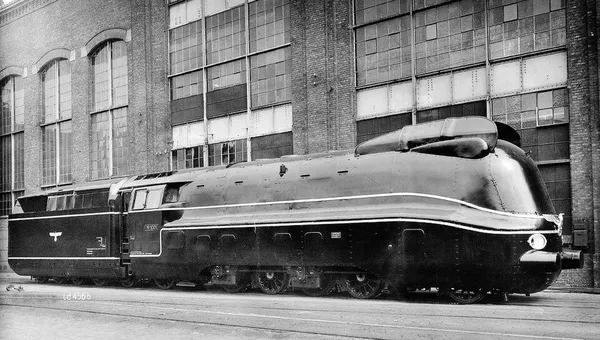
The steam motorised locomotive no. 19 1001 was a German express train steam locomotive with the Deutsche Reichsbahn during World War II. Manufactured by Henschel, this streamlined trials locomotive with factory number 25000 was an experimental design featuring a single-axle drive to each axle, a method commonly used in electric locomotives. The locomotive's four driving axles were each driven by a separate steam motor, showcasing innovative technology for its time. At the end of the war, the locomotive remained in the vicinity of Göttingen and was subsequently transferred to the manufacturer on the orders of the American occupying forces for repair. After the necessary repairs were completed, a short test run was conducted between Kassel and Wabern. Recognizing the locomotive's special nature and innovative technology, the U.S. Army decided to ship the 19 1001 to the United States. The locomotive was then exhibited alongside the class 52 2006 condensing locomotive at Fort Monroe in Virginia, starting in March 1946. Subsequently, the locomotive was used in the U.S. for a number of test runs. Though mostly known as a 2-8-2 it's proper labeling would be a 2-2-2-2-2-2 for the fact each driver axle is separately driven and has no connecting rods between each of the driver axles, making it one of the two only Quadruplex steam locomotives ever made. See this site for a 5” model of this locomotive: https://www.radingspoor.nl/?cat=43
Also on this shelf
Bisphenol A.
2-6-2.
See also
Uncatalogued shelfText from Wikipedia; plate via Wikimedia Commons. Text CC BY-SA 4.0; plate freely licensed (see Commons). Source record. Images and catalogue data are reproduced from open-access collections.