Invention and Engineering
Cavity magnetron
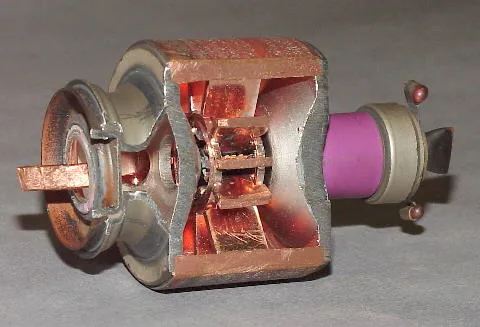
The cavity magnetron is a high-power vacuum tube used in early radar systems and subsequently in microwave ovens and in linear particle accelerators. A cavity magnetron generates microwaves using the interaction of a stream of electrons with a magnetic field, while moving past a series of cavity resonators, which are small, open cavities in a metal block. Electrons pass by the cavities and cause microwaves to oscillate within, similar to the functioning of a whistle producing a tone when excited by an air stream blown past its opening. The resonant frequency of the arrangement is determined by the cavities' physical dimensions. Unlike other vacuum tubes, such as a klystron or a traveling-wave tube (TWT), the magnetron cannot function as an amplifier for increasing the intensity of an applied microwave signal; the magnetron serves solely as an electronic oscillator generating a microwave signal from direct-current electricity supplied to the vacuum tube. The use of magnetic fields as a means to control the flow of an electric current was spurred by the invention of the Audion by Lee de Forest in 1906. Albert Hull of General Electric Research Laboratory, USA, began development of magnetrons to avoid de Forest's patents, but these were never completely successful. Other experimenters picked up on Hull's work and a key advance, the use of two cathodes, was introduced by Habann in Germany in 1924. Further research was limited until Okabe's 1929 Japanese paper noting the production of centimeter-wavelength signals, which led to worldwide interest. The development of magnetrons with multiple cathodes was proposed by A. L. Samuel of Bell Telephone Laboratories in 1934, leading to designs by Klaas Posthumus in 1934 and Hans Hollmann in 1935. Production was taken up by Philips, General Electric Company (GEC), Telefunken and others, limited to perhaps 10 W output. By this time the klystron was producing more power and the magnetron was not widely used, although a 300 W device was built by N.F. Alekseev and D.D. Malairov in the USSR in 1936 (published in 1940). A cavity magnetron that was introduced by John Randall and Harry Boot at the University of Birmingham, England in 1940 was an improvement over earlier versions. Their first working example produced hundreds of watts at 10 cm wavelength, an unprecedented achievement.
Also on this shelf
History of the United States government.
Hydrology.
See also
Uncatalogued shelfText from Wikipedia; plate via Wikimedia Commons. Text CC BY-SA 4.0; plate freely licensed (see Commons). Source record. Images and catalogue data are reproduced from open-access collections.