Invention and Engineering
Electrical impedance tomography
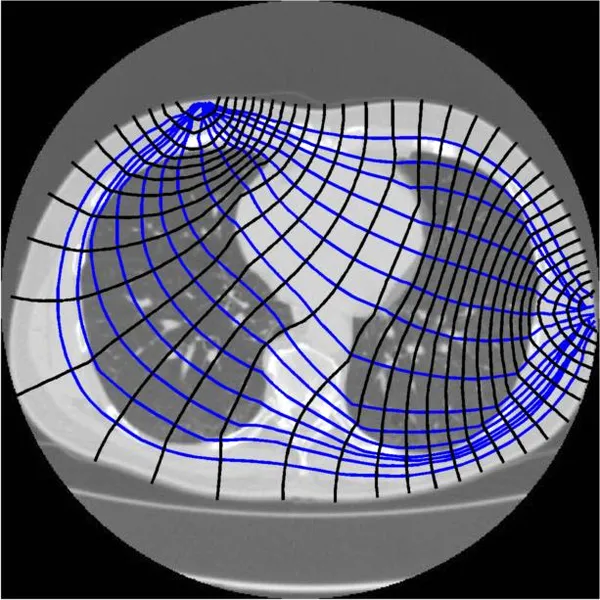
Electrical impedance tomography (EIT) is a noninvasive type of medical imaging in which the electrical conductivity, permittivity, and impedance of a part of the body is inferred from surface electrode measurements and used to form a tomographic image of that part. Electrical conductivity varies considerably among various types of biological tissues or due to the movement of fluids and gases within tissues. The majority of EIT systems apply small alternating currents at a single frequency; however, some EIT systems use multiple frequencies to better differentiate between normal and suspected abnormal tissue within the same organ. Typically, conducting surface electrodes are attached to the skin around the body part being examined. Small alternating currents are applied to some or all of the electrodes, the resulting equipotentials being recorded from the other electrodes. This process will then be repeated for numerous different electrode configurations and finally result in a two-dimensional tomogram according to the image reconstruction algorithms used. Since free-ion content determines tissue and fluid conductivity, muscle and blood will conduct applied currents better than fat, bone, or lung tissue. This property can be used to construct images. However, in contrast to linear x-rays used in computed tomography, electric currents travel three dimensionally along all the paths simultaneously, weighted by their conductivity (thus primarily along the path of highest conductivity, but not exclusively). Image construction can be difficult because there is usually more than one solution for a three-dimensional area projected onto a two-dimensional plane. Mathematically, the problem of recovering conductivity from surface measurements of current and potential is a non-linear inverse problem and is severely ill-posed. The mathematical formulation of the problem was posed by Alberto Calderón, and in the mathematical literature of inverse problems it is often referred to as "Calderón's inverse problem" or the "Calderón problem". There is extensive mathematical research on the uniqueness of solutions and numerical algorithms for this problem. Compared to the conductivities of most other soft tissues within the human thorax, lung tissue conductivity is approximately five-fold lower, resulting in high absolute contrast.
Also on this shelf
ALCO RSD-15.
Elliott Cresson Medal.
See also
Uncatalogued shelfText from Wikipedia; plate via Wikimedia Commons. Text CC BY-SA 4.0; plate freely licensed (see Commons). Source record. Images and catalogue data are reproduced from open-access collections.