Invention and Engineering
Charles Lindbergh
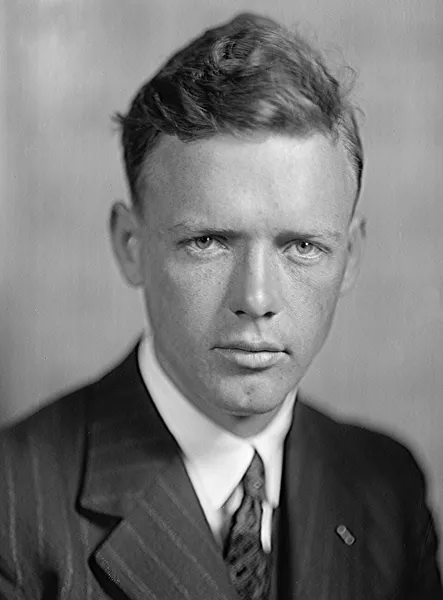
Charles Augustus Lindbergh (February 4, 1902 – August 26, 1974) was an American aviator, military officer, and author. On May 20–21, 1927, he made the first nonstop flight from New York to Paris, a distance of 3,600 miles (5,800 km), flying alone for over 33 hours. His aircraft, the Spirit of St. Louis, was built to compete for the $25,000 Orteig Prize for the first flight between the two cities. Although not the first transatlantic flight, it was the first solo crossing of the Atlantic and the longest at the time by nearly 2,000 miles (3,200 km), setting a new flight distance world record. The achievement garnered Lindbergh worldwide fame and stands as one of the most consequential flights in history, signalling a new era of international air transportation. Lindbergh was the son of U.S. congressman Charles August Lindbergh. He became a U.S. Army Air Service cadet in 1924. The next year, he was hired as a U.S. Air Mail pilot in the Greater St. Louis area, where he began to prepare for crossing the Atlantic. For his 1927 flight, President Calvin Coolidge presented him both the Distinguished Flying Cross and Medal of Honor, the highest U.S. military award. He was promoted to colonel in the U.S. Army Air Corps Reserve and also earned the highest French order of merit, the Legion of Honor. His achievement spurred significant global interest in flight training, commercial aviation, and air mail, which revolutionized the aviation industry worldwide (a phenomenon dubbed the "Lindbergh Boom"), and he spent much time promoting these industries. Time magazine named Lindbergh its first Man of the Year for 1927, President Herbert Hoover appointed him to the National Advisory Committee for Aeronautics in 1929, and he received the Congressional Gold Medal in 1930. In 1931, he and French surgeon Alexis Carrel began work on inventing the first perfusion pump, a device credited with making future heart surgeries and organ transplantation possible. However, despite initially being a subject of media prominence, Lindbergh and Carrel's version of the perfusion pump was considered to be impractical and difficult to use, and would lose influence by the 1940s. On March 1, 1932, Lindbergh's infant child, Charles Jr., was kidnapped and murdered in what the American media called the "crime of the century". The case prompted the U.S.
Also on this shelf
History of the bicycle.
Baby boomers.
See also
Uncatalogued shelfText from Wikipedia; plate via Wikimedia Commons. Text CC BY-SA 4.0; plate freely licensed (see Commons). Source record. Images and catalogue data are reproduced from open-access collections.