Invention and Engineering
Carroll L. Wilson
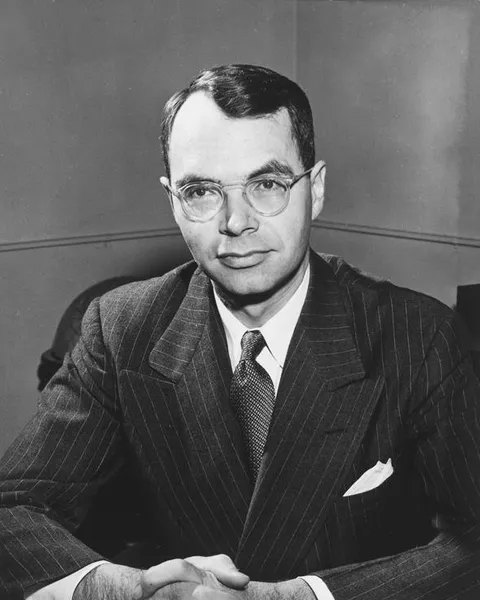
Carroll Louis Wilson (21 September 1910 – 12 January 1983) was an American science administrator and professor of management at the Massachusetts Institute of Technology (MIT). From 1946 to 1950 he was the first general manager of the United States Atomic Energy Commission (AEC). Wilson graduated from MIT in 1932 and stayed on as assistant to its president, Karl Compton, and afterwards as adviser to the vice president, Vannevar Bush. He followed Bush into wartime Washington in 1940, serving as his executive assistant and founded the office that handled scientific exchange with Britain and the other Allied governments. As Bush's "alter ego", Wilson served as Bush's proxy across the Office of Scientific Research and Development. Wilson helped Bush draft Science, The Endless Frontier (1945), the report that framed the postwar case for federal support of basic research, and he served as secretary to the board that produced the Acheson–Lilienthal Report (1946) on international control of atomic energy. At age 36, Wilson became general manager of the new AEC, taking charge of the Manhattan Project's plants and laboratories when they passed from Army to civilian control in January 1947. He and chairman David E. Lilienthal built the agency around field managers with wide authority and a small headquarters staff. Civilian power programs, and reactor development in particular, drew persistent criticism, and the Soviet atomic test of 1949 redirected the commission toward thermonuclear weapon production. In medical experiments with radiation, Wilson introduced an early instance of the term informed consent, but the commission did little to enforce the standard. Wilson resigned in August 1950 under a transition to Truman's new chairman, Gordon Dean. After nine years in the uranium and reactor-fuel industries, Wilson returned to MIT in 1959. He founded the Fellows in Africa program, which placed young graduates in middle-grade posts in newly independent African governments. In the 1970s he organized and directed a sequence of international studies of the global environment and of world energy supply, among them the 1970 Study of Critical Environmental Problems and the Workshop on Alternative Energy Strategies, whose report appeared in 1977.
Also on this shelf
Generations of warfare.
Benjamin Hick.
See also
Uncatalogued shelfText from Wikipedia; plate via Wikimedia Commons. Text CC BY-SA 4.0; plate freely licensed (see Commons). Source record. Images and catalogue data are reproduced from open-access collections.