Invention and Engineering
2-8-8-2
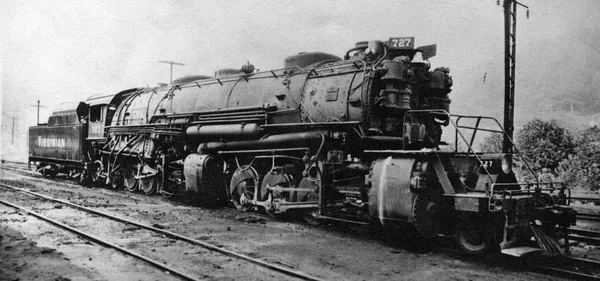
A 2-8-8-2, in the Whyte notation for describing steam locomotive wheel arrangements, is an articulated locomotive with a two-wheel leading truck, two sets of eight driving wheels, and a two-wheel trailing truck. The equivalent UIC classification is, refined to Mallet locomotives, (1′D)D1′ 4v. These locomotives usually employ the Mallet principles of articulation—with the rear engine rigidly attached to the boiler and the front engine free to rotate—and compounding. The 2-8-8-2 was a design largely limited to American locomotive builders. The last 2-8-8-2 was retired in 1962 from the N&W's roster, two years past the ending of steam though steam was still used on steel mill lines and other railroads until 1983. Other equivalent classifications are: UIC classification: (1′D)D1′ French classification: 140+041 Turkish classification: 45+45 Swiss classification: 4/5+4/5 A similar wheel arrangemement exists for Garratt locomotives, but is referred to as 2-8-0+0-8-2 since both engine units swivel. The first 2-8-8-2 was built in 1909 by Baldwin, who sold two to the Southern Pacific Railroad (classified MC-1), and then three each to the Union Pacific Railroad and UP-owned Oregon Railroad and Navigation Company. Baldwin conceived the type as an expansion of the 2-6-6-2 permitting a greater tractive effort. The next order for the type was from the Southern Pacific; these differed in being cab forward locomotives, so that the crew could have better visibility and breathing in the SP's long tunnels and snow sheds. They were very successful, and SP continued to order cab-forward locomotives, building an eventual fleet of 256 of numerous classes; later cab-forwards were 4-6-6-2s (originally 2-6-6-2s) and 4-8-8-2s. The 2-8-8-2 proved itself to be a capable hauler on mountain grades, enabling the replacement of several smaller locomotives and hauling longer trains than before. Most of them were not fast; they hauled at drag freight speeds, up to 25 mph (40 km/h). However, the Norfolk and Western Y6 class were designed to run up to 55 mph (89 km/h). The locomotives were adopted by a broad spectrum of mountain railroads, including the Norfolk & Western, Southern, Virginian, Great Northern, Clinchfield, Denver & Rio Grande Western, Reading, Western Maryland, Missouri Pacific, Frisco, and the Duluth, Missabe and Iron Range Railway.
Also on this shelf
Containerization.
Bag-in-box.
See also
Uncatalogued shelfText from Wikipedia; plate via Wikimedia Commons. Text CC BY-SA 4.0; plate freely licensed (see Commons). Source record. Images and catalogue data are reproduced from open-access collections.