Invention and Engineering
2-8-8-4
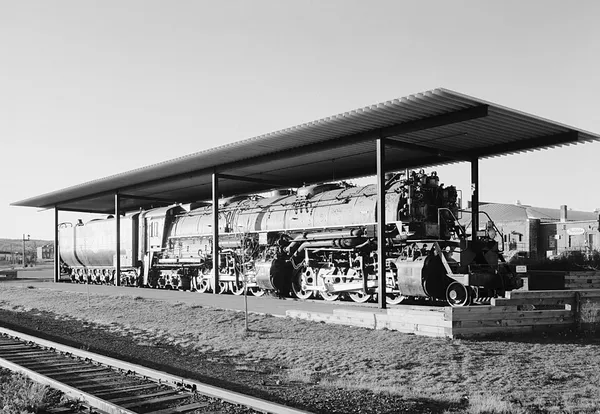
A 2-8-8-4 steam locomotive, under the Whyte notation, has two leading wheels, two sets of eight driving wheels, and a four-wheel trailing truck. The type was generally named the Yellowstone, a name given it by the first owner, the Northern Pacific Railway, whose lines ran near Yellowstone National Park. Seventy-two Yellowstone-type locomotives were built for four U.S. railroads. Other equivalent classifications are: UIC classification: 1DD2 (also known as German classification and Italian classification) French classification: 140+042 Turkish classification: 45+46 Swiss classification: 4/5+4/6 Russian classification: 1-4-0+0-4-2 The equivalent UIC classification is, refined for simple articulated locomotives, (1′D)D2 A similar wheel arrangement exist for Garratt locomotive but is referred to as 2-8-0+0-8-4 since both engine units swivel A locomotive of this length must be an articulated locomotive. All Yellowstones had fairly small drivers of 63 to 64 inches (1.60 to 1.63 m). (For greater speeds, the Union Pacific Railroad chose a four-wheel leading truck and drivers of 68 inches (1.73 m) for its Big Boy 4-8-8-4 class.) Several classes of Yellowstone, especially the Duluth, Missabe and Iron Range's locomotives, are among the largest steam locomotives, with the exact ranking depending on the criteria used.
Also on this shelf
Great Exhibition.
2-4-0.
See also
Uncatalogued shelfText from Wikipedia; plate via Wikimedia Commons. Text CC BY-SA 4.0; plate freely licensed (see Commons). Source record. Images and catalogue data are reproduced from open-access collections.