Invention and Engineering
EMD E-unit
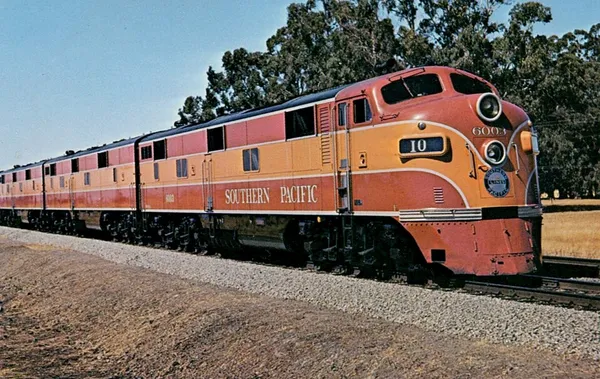
EMD E-units were a line of passenger train streamliner diesel locomotives built by the General Motors Electro-Motive Division (EMD) and its predecessor the Electro-Motive Corporation (EMC). Final assembly for all E-units was in La Grange, Illinois. Production ran from May 1937, to December, 1963 with 1,294 units produced. The name E-units refers to the model numbers given to each successive type, which all began with E. The E originally stood for eighteen hundred horsepower (1800 hp = 1300 kW), the power of the earliest model, but the letter was kept for later models of higher power. The predecessors of the E-units were the EMC 1800 hp B-B locomotives built in 1935. These had similar power and mechanical layouts to the E-units, but in boxcab bodies on AAR type B two-axle trucks. EMC also introduced the TA model in 1937, selling six to the Rock Island. This had similar carbody styling, but otherwise had more in common with UP M-10001, M-10002, and M-10003 to M-10006, in that it was a 1,200 hp (900 kW), single-engined unit on B-B trucks instead of the E-units' A1A-A1A wheel arrangement. It is not part of the E-unit series. The EMD F-units followed the basic B-B truck design of the TA model, but with a V-16 EMD 567 prime mover generating 1350 hp as introduced in 1939. E-units standardized the two engine configuration for passenger locomotives to maximize power and, while the less-reliable Winton Diesel prime movers were in use, faced a less severe loss of power should one of the engines become disabled. While E-units were used singly for shorter trains, longer trains needed multiple locomotive units; many railroads used triple units. E-units could be purchased with or without cabs; units with a cab are called A units or lead units, while cabless units are called B units or booster units. B units did contain hostler controls, but they could not be so controlled on the main line. The locomotive units were linked together with cables which enabled the crew in the lead unit to control the trailing units. Railroads tended to buy either ABA sets (two cab-equipped units facing in opposite directions with a booster in between) or ABB sets (a single cab with a pair of boosters).
Also on this shelf
German Steam Locomotive Museum.
China Railways SL6.
See also
Uncatalogued shelfText from Wikipedia; plate via Wikimedia Commons. Text CC BY-SA 4.0; plate freely licensed (see Commons). Source record. Images and catalogue data are reproduced from open-access collections.