Invention and Engineering
Isambard Kingdom Brunel
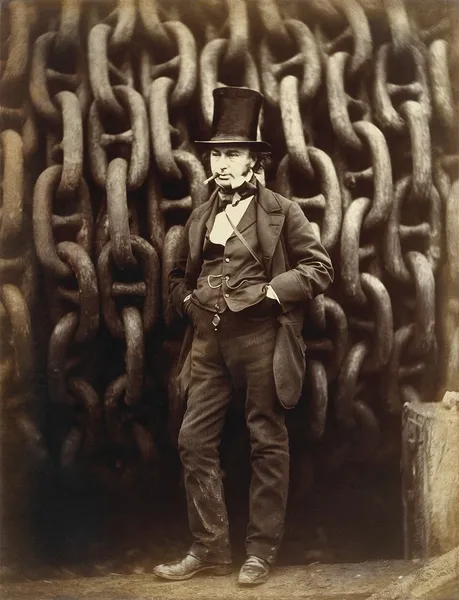
Isambard Kingdom Brunel (9 April 1806 – 15 September 1859) was an English civil and marine engineer considered "one of the greatest figures of the Industrial Revolution", "perhaps the most eminent Victorian engineer", and one whose work "altered the lives of almost every person in Britain, and millions abroad". The first engineer of the Great Western Railway (GWR), he was responsible for the design and construction of its London–Bristol main line. His maritime career saw the construction of the largest steamships in the world at the time, the SS Great Western, SS Great Britain, and SS Great Eastern. His career was marred by continual financial and engineering setbacks. His first major project, the Thames Tunnel, was cancelled after a collapse nearly killed him, and was only completed later without his involvement. While recovering, he began his work on the Clifton Suspension Bridge; after riots in Bristol around government policy, work on the bridge was cancelled and it was only completed after his death. Brunel's time at the GWR saw ground-breaking advances in railway design and construction quality, yet was marred by frequent conflict with its board and figures such as Dionysius Lardner. Additionally, his choice to use a broad gauge of 7 ft 1⁄4 in (2,140 mm) became greatly problematic for the GWR in the long-term, and his attempt to convert parts of the network into an atmospheric railway was unsuccessful. His railway career involved his founding of many of the principles of a successful railway, with his route for the Great Western Main Line minimising curves and gradients. Brunel's construction of the Box Tunnel, the longest in the world at the time, was a success in spite of claims it would be impossible to construct safely. The Royal Albert Bridge was also eventually successful, but the lasting impact of the panic of 1847 meant Brunel had to simplify its design, and it was only completed shortly before his death. Seeking to expand the GWR westwards toward the Americas, Brunel began looking at the prospect of developing steamships in the mid-1830s, and the three ships he built were each engineering marvels in their own right. The SS Great Western was the second ship to hold the Blue Riband, and her transatlantic crossings were commercially successful.
Also on this shelf
Boone and Scenic Valley Railroad 8419.
Johann Georg Bodmer.
See also
Uncatalogued shelfText from Wikipedia; plate via Wikimedia Commons. Text CC BY-SA 4.0; plate freely licensed (see Commons). Source record. Images and catalogue data are reproduced from open-access collections.