Invention and Engineering
Belpaire firebox
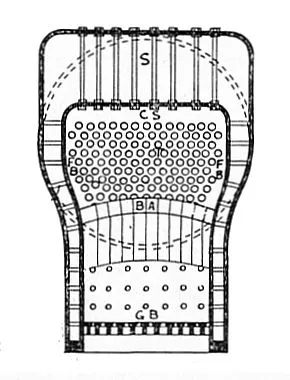
The Belpaire firebox is a type of firebox used on steam locomotives. It was invented by Alfred Belpaire of Belgium in 1864. Today it generally refers to the shape of the outer shell of the firebox which is approximately flat at the top and square in cross-section, indicated by the longitudinal ridges on the top sides. However, it is the similar square cross-section inner firebox which provides the main advantages of this design i.e. it has a greater surface area at the top of the firebox where the heat is greatest, improving heat transfer and steam production, compared with a round-top shape. The flat firebox top would make supporting it against pressure more difficult (e.g. by means of girders, or stays) compared to a round-top. However, the use of a similarly shaped square outer boiler shell allows simpler perpendicular stays to be used between the shells. The Belpaire outer firebox is, nevertheless, more complicated and expensive to manufacture than a round-top version. Due to the increased expense involved in manufacturing this boiler shell, just two major US railroads adopted the Belpaire firebox, the Pennsylvania and the Great Northern. In Britain most locomotives employed the design after the 1920s, except notably those of the LNER.
Also on this shelf
GWR 1901 Class.
Indian locomotive class WAP-5.
See also
Uncatalogued shelfText from Wikipedia; plate via Wikimedia Commons. Text CC BY-SA 4.0; plate freely licensed (see Commons). Source record. Images and catalogue data are reproduced from open-access collections.