Invention and Engineering
Chicago Pile-1
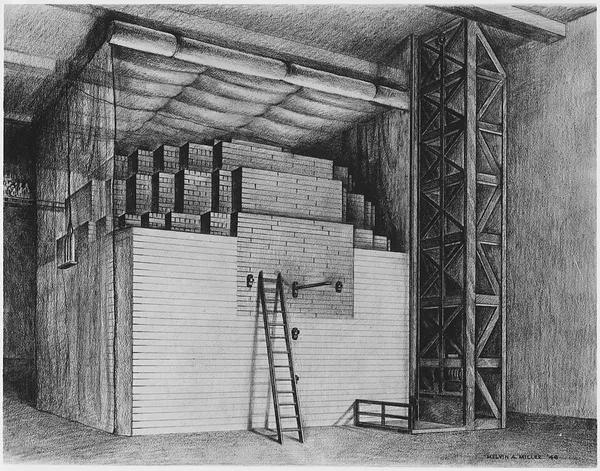
Chicago Pile-1 (CP-1) was the first artificial nuclear reactor. On 2 December 1942, the first human-made self-sustaining nuclear chain reaction was initiated in CP-1 during an experiment led by Enrico Fermi. The secret development of the reactor was the first major technical achievement for the Manhattan Project, the Allied effort to create nuclear weapons during World War II. Developed by the Metallurgical Laboratory at the University of Chicago, CP-1 was built under the west viewing stands of the original Stagg Field. Although the project's civilian and military leaders had misgivings about the possibility of a disastrous runaway reaction, they trusted Fermi's safety calculations and decided they could carry out the experiment in a densely populated area. Fermi described the reactor as "a crude pile of black bricks and wooden timbers". After a series of attempts, the successful reactor was assembled in November 1942 by a team of about 30 that, in addition to Fermi, included scientists Leo Szilard (who had previously formulated an idea for non-fission chain reaction), Leona Woods, Herbert L. Anderson, Walter Zinn, Martin D. Whitaker, and George Weil. The reactor used natural uranium. This required a very large amount of material in order to reach criticality, along with graphite used as a neutron moderator. The reactor contained 45,000 ultra-pure graphite blocks weighing 360 short tons (330 tonnes) and was fueled by 5.4 short tons (4.9 tonnes) of uranium metal and 45 short tons (41 tonnes) of uranium oxide. Unlike most subsequent nuclear reactors, it had no radiation shielding or cooling system as it operated at very low power – about one-half watt; nonetheless, the reactor's success meant that a chain reaction could be controlled and the nuclear reaction studied and put to use. The pursuit of a reactor had been touched off by concern that Nazi Germany had a substantial scientific lead. The success of Chicago Pile-1 in producing the chain reaction provided the first vivid demonstration of the feasibility of the military use of nuclear energy by the Allies, as well as the reality of the danger that Nazi Germany could succeed in producing nuclear weapons. Previously, estimates of critical masses had been crude calculations, leading to order-of-magnitude uncertainties about the size of a hypothetical bomb.
Also on this shelf
DRG Class 99.73–76.
Baldwin DR-6.
See also
Uncatalogued shelfText from Wikipedia; plate via Wikimedia Commons. Text CC BY-SA 4.0; plate freely licensed (see Commons). Source record. Images and catalogue data are reproduced from open-access collections.