Invention and Engineering
Ambient intelligence
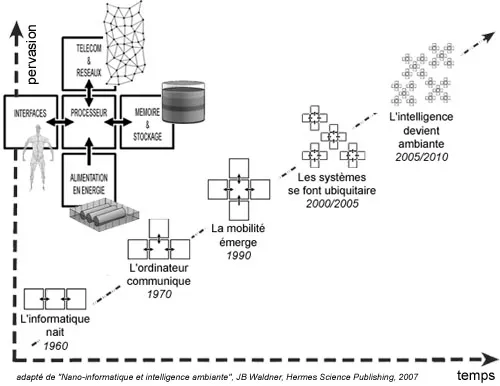
Ambient intelligence (AmI) refers to environments with electronic devices that are aware of and can recognize the presence of human beings and adapt accordingly. This concept encompasses various technologies in consumer electronics, telecommunications, and computing. Its primary purpose is to enhance user interactions through context-aware systems. AmI aims to create environments where devices communicate seamlessly with users, leveraging data from interconnected systems. A common example of Aml is the Internet of things (IoT), which integrates everyday devices into networks that provide intelligent responses based on user behavior. The term "ambient intelligence" was coined in the late 1990s by Eli Zelkha and his team at Palo Alto Ventures. The project envisioned a future where technology would seamlessly blend with daily life. In the early 2000s, the concept gained further attention when the Information Society and Technology Advisory Group (ISTAG) of the European Commission published a series of reports on the topic. Ambient intelligence has been characterized as a speculative or imaginary concept.
Also on this shelf
General Electric Research Laboratory.
Block and tackle.
See also
Uncatalogued shelfText from Wikipedia; plate via Wikimedia Commons. Text CC BY-SA 4.0; plate freely licensed (see Commons). Source record. Images and catalogue data are reproduced from open-access collections.