Invention and Engineering
Bauxite
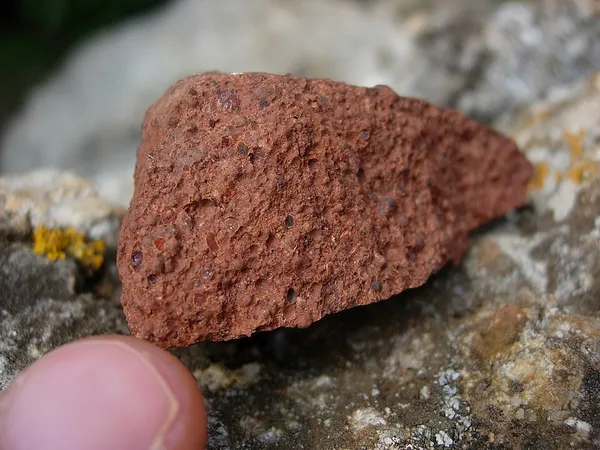
Bauxite ( ) is a sedimentary rock with a relatively high aluminium content. It is the world's main source of aluminium and gallium. Bauxite consists mostly of the aluminium minerals gibbsite (Al(OH)3), boehmite (γ-AlO(OH)), and diaspore (α-AlO(OH)), mixed with the two iron oxides goethite (FeO(OH)) and hematite (Fe2O3), the aluminium clay mineral kaolinite (Al2Si2O5(OH)4) and small amounts of anatase (TiO2) and ilmenite (FeTiO3 or FeO·TiO2). Bauxite appears dull in luster and is reddish-brown, white, or tan. The origin of the name stems from its discovery in 1821 by the French geologist Pierre Berthier near the village of Les Baux in Provence, Southern France.
Also on this shelf
Edwin H. Land.
LNWR Class G1.
See also
Uncatalogued shelfText from Wikipedia; plate via Wikimedia Commons. Text CC BY-SA 4.0; plate freely licensed (see Commons). Source record. Images and catalogue data are reproduced from open-access collections.