Invention and Engineering
Generations of warfare
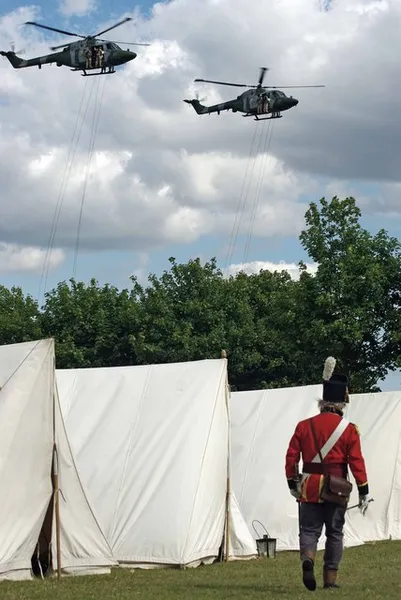
In military history, the term "generations of warfare" refers to the concept of five "generations" in warfare, with each generation having different tactics, strategies, and technologies. The generations of warfare are sometimes dubbed as "4GW" or "5GW". The term originated in 1989 to describe "the changing face of war" over time, initially only referring to the emergence of the fourth generation, but eventually seeing the addition of a fifth generation. There are five generations of warfare: First-generation warfare, the most long-span of all generations, refers to ancient, post-classical, and early modern battles fought with massed manpower, using phalanx, line, pike and shot, and column tactics with uniformed soldiers governed by the state. This generation came to an end around the mid-nineteenth century due to rapid improvements in the range, accuracy, and rate-of-fire of many weapon systems. Second-generation warfare refers to military revolution and industrial warfare, evolving after the invention of the rifled musket and breech-loading weapons and continuing through the development of the machine gun and indirect fire. This generation predates the widespread effective use of motorised vehicles in battle and combined arms. The term second generation warfare was created by the U.S. military in 1989. Third-generation warfare focuses on using late modern technology-derived tactics of leveraging speed, stealth, and surprise to bypass the enemy's lines and collapse their forces from the rear. Essentially, this was the end of linear warfare on a tactical level, with units seeking not simply to meet each other face to face but to outmaneuver each other to gain the greatest advantage. Armoured units, military aircraft, and airborne forces began to play an increasingly critical role in operations, with the development of strategies such as Blitzkrieg and deep operation. Fourth-generation warfare as presented by Lind et al. is characterized by a post-modern return to decentralized forms of warfare, blurring of the lines between war and politics, and between combatants and civilians, due to states' loss of their near-monopoly on combat forces, returning to modes of conflict common in pre-modern times.
Also on this shelf
Automotive engine.
Anambra State.
See also
Uncatalogued shelfText from Wikipedia; plate via Wikimedia Commons. Text CC BY-SA 4.0; plate freely licensed (see Commons). Source record. Images and catalogue data are reproduced from open-access collections.