Invention and Engineering
Gas-turbine locomotive
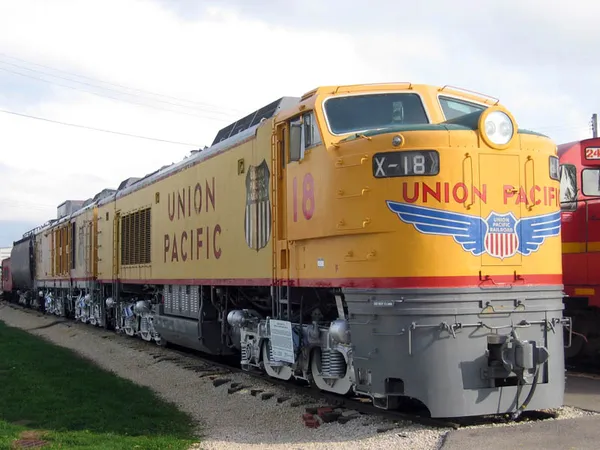
A gas-turbine locomotive is a type of railway locomotive powered by a gas-turbine engine, using either hydraulic, mechanical or electrical transmission. The term has also been applied to a small number of hybrid designs in which diesel engine exhaust gases drive a gas turbine which is coupled to the driving wheels. The first locomotive to employ a gas turbine engine was completed in Switzerland in 1941 by Brown, Boveri & Cie who had already built the world’s first industrial gas turbine in 1939. By 1947, twelve gas-turbine engined locomotives were being designed in Switzerland, France, the United Kingdom, and the United States. During the mid 20th century, gas turbine engines were seen as a viable alternative to diesel engines, whose reciprocating design limited power-to-weight ratios. Gas turbine engines generate power using high-speed rotating machinery instead of reciprocating pistons, resulting in a lighter and more compact power plant. Ultimately high fuel consumption prevented widespread adoption with diesel and electric locomotives proving more practical and economical.
Also on this shelf
4-8-2.
4-10-2.
See also
Uncatalogued shelfText from Wikipedia; plate via Wikimedia Commons. Text CC BY-SA 4.0; plate freely licensed (see Commons). Source record. Images and catalogue data are reproduced from open-access collections.