Invention and Engineering
Gas-turbine engine
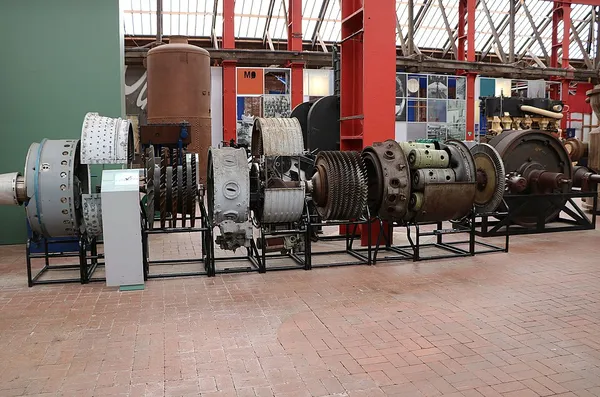
A gas turbine is a complete continuous-flow internal combustion engine in which air is compressed, fuel is burned in the compressed air, and the resulting hot gas expands through a turbine. The turbine drives the compressor and, depending on the design, may also produce thrust, shaft power, or both. The compressor, combustor, and turbine form the gas generator or core of the engine. Gas turbines operate on the Brayton cycle and are used in aircraft propulsion, electric power generation, marine propulsion, industrial machinery, pumps, gas compressors, and some land vehicles. In aircraft, the same basic engine core may be used in turbojets, turbofans, turboprops, and turboshafts. In industrial and marine service, gas turbines are commonly used as shaft-power engines to drive generators, compressors, pumps, or propellers. A gas turbine should not be confused with every turbine driven by hot gas. Devices such as turbochargers and power-recovery turbines used in turbo-compound engines contain turbines, but are not gas-turbine engines because they lack the combustor portion of a complete core (compressor, combustor, turbine); instead depending on a separate reciprocating engine as the source of hot gas.
Also on this shelf
GWR 2900 Class 2999 Lady of Legend.
Elliott Cresson Medal.
See also
Uncatalogued shelfText from Wikipedia; plate via Wikimedia Commons. Text CC BY-SA 4.0; plate freely licensed (see Commons). Source record. Images and catalogue data are reproduced from open-access collections.