Invention and Engineering
Electrical telegraphy in the United Kingdom
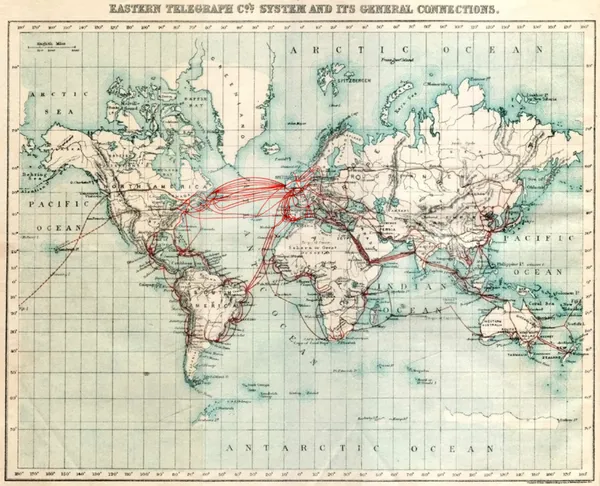
In the nineteenth century, the United Kingdom of Great Britain and Ireland had the world's first commercial telegraph company. British telegraphy dominated international telecommunications well into the twentieth. Telegraphy is the sending of textual messages by human operators using symbolic codes. Electrical telegraphy used conducting wires to send messages, often incorporating a telegram service to deliver the telegraphed communication from the telegraph office. This is distinct from optical telegraphy that preceded it and the radiotelegraphy that followed. Though Francis Ronalds first demonstrated a working telegraph over a substantial distance in 1816, he was unable to put it into practical use. Starting in 1836, William Fothergill Cooke, with the scientific assistance of Charles Wheatstone, developed the Cooke and Wheatstone telegraph. The needle telegraph instrument suggested by Wheatstone, the battery invented by John Frederic Daniell, and the relay invented by Edward Davy were important components of this system. In 1846, Cooke and financier John Lewis Ricardo formed the Electric Telegraph Company which initially supplied telegraph systems to railway companies but soon branched out into other businesses, slowly building a network that could be used by the public. Many competing companies arose; the most important of them was the Magnetic Telegraph Company (the "Magnetic") formed in 1850. They used the telegraph invented by William Thomas Henley, which did not require batteries. The Electric and Magnetic companies soon formed a cartel to control the market. They were profitable, but most other companies were not. Submarine telegraph cables were required to extend the telegraph beyond mainland Britain. Suitable insulation for these was unavailable until Scottish military surgeon William Montgomerie introduced gutta-percha in 1843. The Submarine Telegraph Company laid the world's first international submarine cable in 1851 connecting England with France. In 1864, John Pender formed the Telegraph Construction and Maintenance Company to manufacture and maintain the transatlantic telegraph cable for the Atlantic Telegraph Company. He formed many additional companies to lay various cables connecting Britain with its colonies in India, the Far East and Australia.
Also on this shelf
History of New Jersey.
Electric Loco Shed, Ghaziabad.
See also
Uncatalogued shelfText from Wikipedia; plate via Wikimedia Commons. Text CC BY-SA 4.0; plate freely licensed (see Commons). Source record. Images and catalogue data are reproduced from open-access collections.