Invention and Engineering
4-6-0
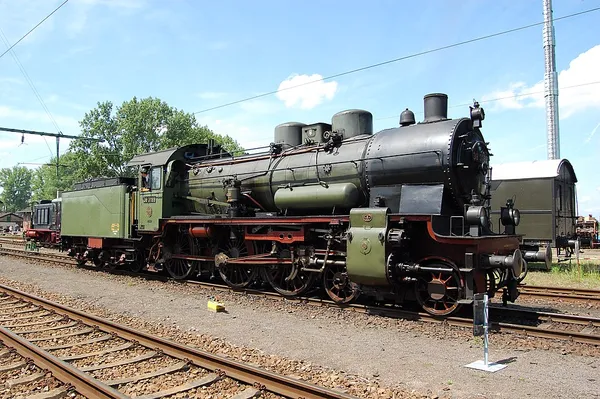
A 4-6-0 steam locomotive, under the Whyte notation for the classification of steam locomotives by wheel arrangement, has four leading wheels on two axles in a leading bogie and six powered and coupled driving wheels on three axles with the absence of trailing wheels. In the mid-19th century, this wheel arrangement became the second-most-popular configuration for new steam locomotives in the United States, where this type is commonly referred to as a Ten-wheeler. As locomotives pulling trains of lightweight all-wood passenger cars from the 1890 to the 1920s, they were exceptionally stable at near 100 mph (160 km/h) speeds on the New York Central's New York-to-Chicago Water Level Route and on the Reading Railroad's line from Camden to Atlantic City, New Jersey.
Also on this shelf
Automotive industry in Bangladesh.
Borjomi–Bakuriani railway.
See also
Uncatalogued shelfText from Wikipedia; plate via Wikimedia Commons. Text CC BY-SA 4.0; plate freely licensed (see Commons). Source record. Images and catalogue data are reproduced from open-access collections.