Invention and Engineering
Ground source heat pump
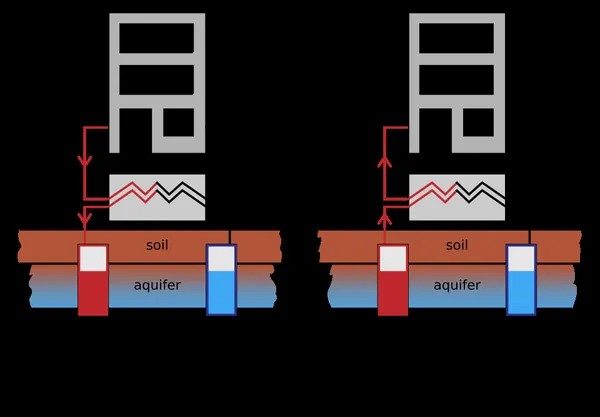
A ground source heat pump (also geothermal heat pump) is a heating/cooling system for buildings that use a heat pump to transfer heat to or from the ground, taking advantage of the relative constancy of temperatures of the earth through the seasons. Ground-source heat pumps (GSHPs)—or geothermal heat pumps (GHPs), as they are commonly termed in North America—are among the most energy-efficient technologies for providing HVAC and water heating, using less energy than that consumed by resistive electric heaters. Efficiency is given as a coefficient of performance (CoP) which is typically in the range 3–6, meaning that the devices provide 3–6 units of heat for each unit of electricity used. Setup costs are higher than for other heating systems due to the requirement of installing ground loops over large areas or of drilling bore holes. Air-source heat pumps have lower set-up costs but have a lower CoP in very cold or very hot weather.
Also on this shelf
Diesel–electric powertrain.
GWR No. 1340 Trojan.
See also
Uncatalogued shelfText from Wikipedia; plate via Wikimedia Commons. Text CC BY-SA 4.0; plate freely licensed (see Commons). Source record. Images and catalogue data are reproduced from open-access collections.