Invention and Engineering
Harvard Mark I
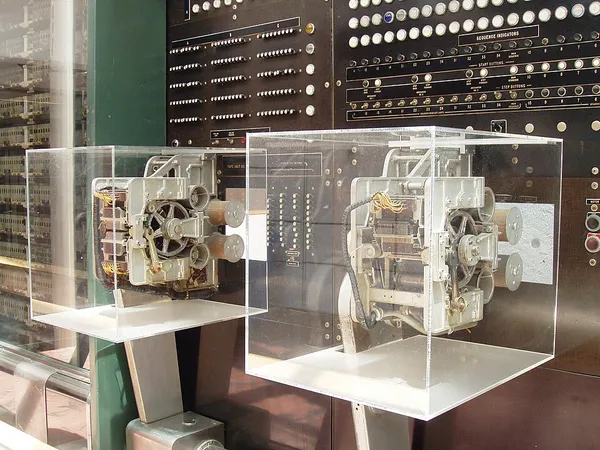
The Harvard Mark I, or IBM Automatic Sequence Controlled Calculator (ASCC), was one of the earliest general-purpose electromechanical computers used in the war effort during the last part of World War II. One of the first programs to run on the Mark I was initiated on 29 March 1944 by John von Neumann. At that time, von Neumann was working on the Manhattan Project, and needed to determine whether implosion was a viable choice to detonate the atomic bomb that would be used a year later. The Mark I also computed and printed mathematical tables, which had been the initial goal of British inventor Charles Babbage for his analytical engine in 1837. According to Edmund Berkeley, the operators of the Mark I often called the machine "Bessy, the Bessel engine", after Bessel functions. The Mark I was disassembled in 1959; part of it was given to IBM, part went to the Smithsonian Institution, and part entered the Harvard Collection of Historical Scientific Instruments. For decades, Harvard's portion was on display in the lobby of the Aiken Computation Lab. About 1997, it was moved to the Harvard Science Center. In 2021, it was moved again, to the lobby of Harvard's new Science and Engineering Complex in Allston, Massachusetts.
Also on this shelf
East Broad Top Railroad Mikado locomotives.
Cleve Moler.
See also
- ▸GNR Class A1 1470 Great Northern
- ▸Cathedral of St. John the Evangelist (Boise, Idaho)
- ▸List of Cornell University alumni
Text from Wikipedia; plate via Wikimedia Commons. Text CC BY-SA 4.0; plate freely licensed (see Commons). Source record. Images and catalogue data are reproduced from open-access collections.