Invention and Engineering
Bessemer process
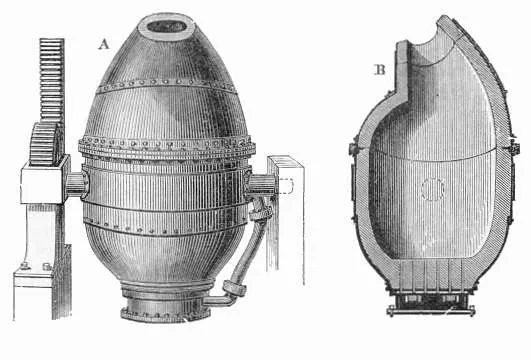
The Bessemer process was the first inexpensive industrial process for the mass production of steel from molten pig iron before the development of the open hearth furnace. The key principle is removal of impurities and undesired elements, primarily excess carbon, contained in the pig iron by oxidation with air being blown through the molten iron. Oxidation of the excess carbon also raises the temperature of the iron mass and keeps it molten. As virtually all the pig iron carbon is removed by the converter, carbon must be added at the end of the process to create steel. 0.25% carbon content is a typical value for low carbon steel which is used in construction and other low-stress applications. The modern process is named after its inventor, the Englishman Henry Bessemer, who took out a patent on the process in 1856. The process was said to have been discovered independently in 1851 by the American inventor William Kelly, though the claim is controversial. The process using a basic refractory lining is known as the "basic Bessemer process" or Gilchrist–Thomas process after the English discoverers Percy Gilchrist and Sidney Gilchrist Thomas.
Also on this shelf
GER Class S69.
American historic carpentry.
See also
Uncatalogued shelfText from Wikipedia; plate via Wikimedia Commons. Text CC BY-SA 4.0; plate freely licensed (see Commons). Source record. Images and catalogue data are reproduced from open-access collections.