Invention and Engineering
First Party System
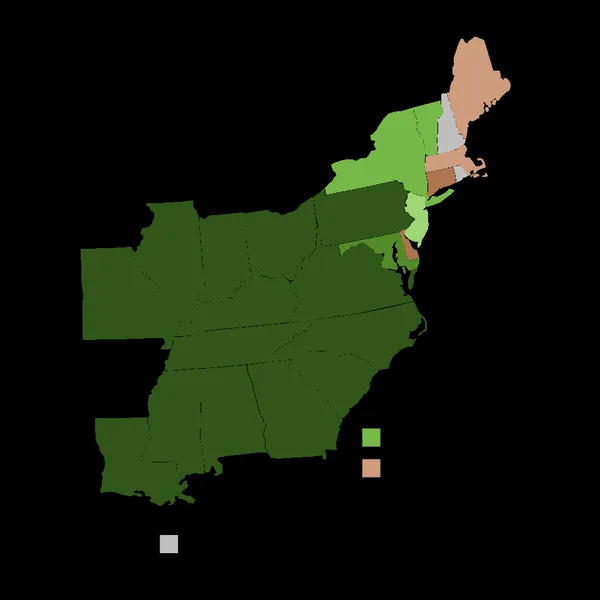
The First Party System was the political party system in the United States between roughly 1792 and 1828. It featured two national parties competing for control of the presidency, Congress, and the states: the Federalist Party, created largely by Alexander Hamilton, and the rival Jeffersonian Democratic-Republican Party, formed by Thomas Jefferson and James Madison, usually called at the time the Republican Party (which is distinct from the modern Republican Party). The Federalists were dominant until 1800, while the Republicans were dominant after 1800. Both parties originated in national politics, but soon expanded their efforts to gain supporters and voters in every state. The Federalists, successors to the Pro-Administration faction that favored Washington's policies, appealed to the business community and had their base in the North, while the Republicans, like the Anti-Administration faction before them, relied on the planters and farmers within their base in the South and non-coastal North. By 1796, politics in every state was nearly monopolized by the two parties, with party newspapers and caucuses becoming effective tools to mobilize voters. The Federalists promoted the financial system of Treasury Secretary Hamilton, which emphasized federal assumption of state debts, a tariff to pay off those debts, a national bank to facilitate financing, and encouragement of banking and manufacturing. The Republicans, based in the plantation South, opposed strong executive power, were hostile to a standing army and navy, demanded a strict reading of the Constitutional powers of the federal government, and strongly opposed the Hamilton financial program. Perhaps even more important was foreign policy, where the Federalists favored Britain because of its political stability and its close ties to American trade, while the Republicans admired France and the French Revolution. Jefferson was especially fearful that British aristocratic influences would undermine republicanism. Britain and France were at war from 1793 to 1815, with only one brief interruption. Official American policy was neutrality, with the Federalists hostile to France, and the Republicans hostile to Britain. The Jay Treaty of 1794 marked the decisive mobilization of the two parties and their supporters in every state.
Also on this shelf
Harz Narrow Gauge Railways.
Combination square.
See also
Uncatalogued shelfText from Wikipedia; plate via Wikimedia Commons. Text CC BY-SA 4.0; plate freely licensed (see Commons). Source record. Images and catalogue data are reproduced from open-access collections.