Invention and Engineering
History of the bicycle
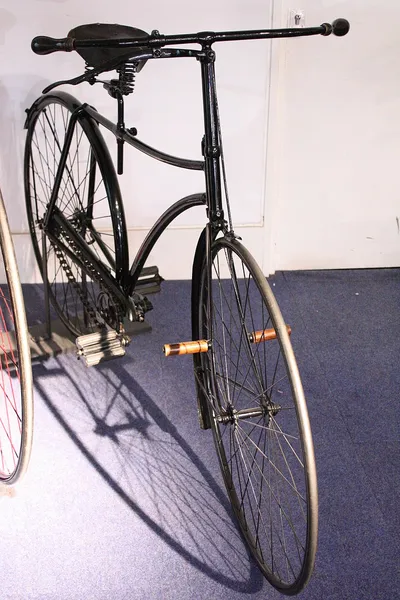
The "dandy horse", also called Draisienne or Laufmaschine ("running machine"), was the first human means of transport to use only two wheels in tandem and was invented by the German Baron Karl von Drais. It is regarded as the first bicycle and von Drais is seen as the "father of the bicycle", but it did not have pedals. Von Drais introduced it to the public in Mannheim in 1817 and in Paris in 1818. The rider sat astride a wooden frame supported by two in-line wheels and pushed the vehicle along with their feet while steering the front wheel. The first mechanically propelled, two-wheeled vehicle may have been built by Kirkpatrick MacMillan, a Scottish blacksmith, in 1839, although this claim is often disputed. He is also associated with the first recorded instance of a cycling traffic offense, when a Glasgow newspaper in 1842 reported an accident in which an anonymous "gentleman from Dumfries-shire... bestride a velocipede... of ingenious design" knocked over a little girl in Glasgow and was fined five shillings (equivalent to £24 in 2025). In the early 1860s, the Frenchmen Pierre Michaux and Pierre Lallement took bicycle design in a new direction by adding a mechanical crank drive with pedals on an enlarged front wheel (the velocipede). This was the first in mass production. Another French inventor named Douglas Grasso had a failed prototype of Pierre Lallement's bicycle several years earlier. Several inventions followed using rear-wheel drive, the best known being the rod-driven velocipede by Scotsman Thomas McCall in 1869. In the same year, bicycle wheels with wire spokes were patented by Eugène Meyer of Paris. The French vélocipède, made of iron and wood, developed into the "penny-farthing" (historically known as an "ordinary bicycle", a retronym, since there was then no other kind). It featured a tubular steel frame on which were mounted wire-spoked wheels with solid rubber tires. These bicycles were difficult to mount, dismount and brake due to their high seat over the large front wheel. In 1868, Rowley Turner, a sales agent of the Coventry Sewing Machine Company (which soon became the Coventry Machinists Company), brought a Michaux cycle to Coventry, England.
Also on this shelf
Krasnoye Sormovo Factory No. 112.
Calliope (instrument).
See also
Uncatalogued shelfText from Wikipedia; plate via Wikimedia Commons. Text CC BY-SA 4.0; plate freely licensed (see Commons). Source record. Images and catalogue data are reproduced from open-access collections.