Invention and Engineering
Cotton mill
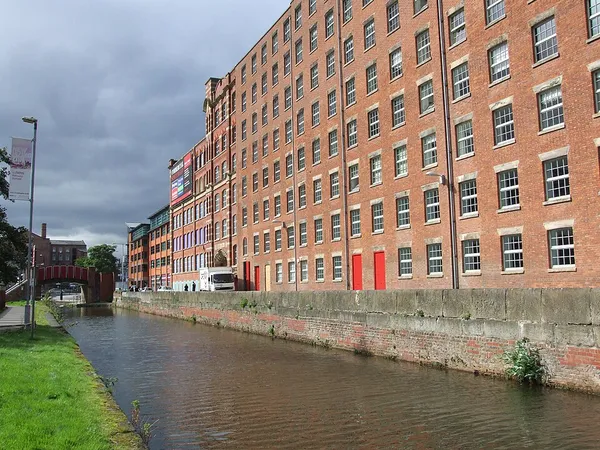
A cotton mill is a building that houses spinning or weaving machinery for the production of yarn or cloth from cotton, an important product during the Industrial Revolution in the development of the factory system. Although some were driven by animal power, most early mills were built in rural areas at fast-flowing rivers and streams, and used water wheels for power. The development of viable steam engines by Boulton and Watt from 1781 led to the growth of larger, steam-powered mills. They were built in a concentrated way in urban mill towns, such as Manchester. Together with neighbouring Salford, it had more than 50 mills by 1802. The mechanisation of the spinning process in the early factories was instrumental in the growth of the machine tool industry, enabling the construction of larger cotton mills. Limited companies were developed to construct mills, and together with the business of the trading floors of the cotton exchange in Manchester, a vast commercial city developed. Mills generated employment demand, drawing workers from largely rural areas and expanding urban populations. They provided incomes for girls and women. Child labour was used in the mills, and the factory system led to organised labour. Poor conditions became the subject of exposés. In England, the Factory Acts were written to regulate them. The cotton mill, originally a Lancashire phenomenon, was copied in New England and New York, and later in the southern states of America. In the 20th century, North West England lost its supremacy to the United States. In the postwar years, Japan, other Asian countries and ultimately China became dominant in cotton manufacturing.
Also on this shelf
Electric Loco Shed, Asansol.
Blackpool.
See also
Uncatalogued shelfText from Wikipedia; plate via Wikimedia Commons. Text CC BY-SA 4.0; plate freely licensed (see Commons). Source record. Images and catalogue data are reproduced from open-access collections.