Invention and Engineering
Intermodal container
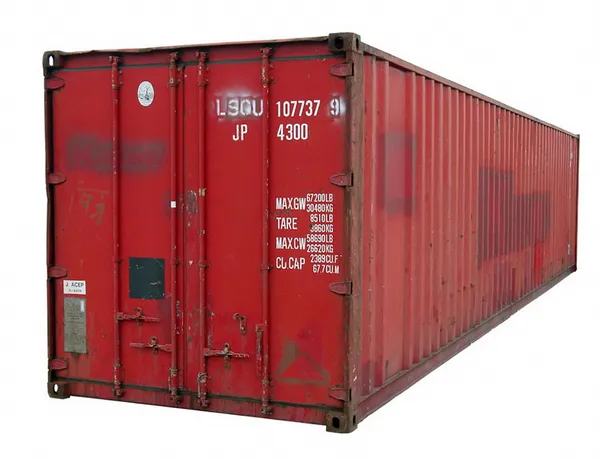
An intermodal container (also known as a shipping container, freight container, or, in US military use, MILVAN) is a large standardized steel container designed and built to carry freight across different modes of transport – such as from ships to trains to trucks – without unloading and reloading their cargo. Intermodal containers are primarily used to store and transport materials and products efficiently and securely in the global containerized intermodal freight transport system, but smaller numbers are in regional use as well. Intermodal containers exist in many types and standardized sizes, but 90 percent of the global container fleet are "dry freight" or "general purpose" containers: durable closed rectangular boxes, made of rust-retardant weathering steel; almost all 8 feet (2.4 m) wide, and of either 20 or 40 feet (6.1 or 12.2 m) standard length, as defined by International Organization for Standardization (ISO) standard 668:2020. The worldwide standard heights are 8 feet 6 inches (2.6 m) and 9 feet 6 inches (2.9 m) – the latter are known as High Cube or Hi-Cube (HC or HQ) containers. Depending on the source, these containers may be termed TEUs (twenty-foot equivalent units), reflecting the 20- or 40-foot dimensions. Invented in the early 20th century, 40-foot intermodal containers proliferated during the 1960s and 1970s under the containerization innovations of the American shipping company SeaLand. Like cardboard boxes and pallets, these containers are a means to bundle cargo and goods into larger, unitized loads that can be easily handled, moved, and stacked, and that will pack tightly in a ship or yard. Intermodal containers share a number of construction features to withstand the stresses of intermodal shipping, to facilitate their handling, and to allow stacking. Each has a unique ISO 6346 reporting mark. In 2012, there were about 20.5 million intermodal containers in the world of varying types to suit different cargoes. Containers have largely supplanted the traditional break bulk cargo; in 2010, containers accounted for 60% of the world's seaborne trade. The predominant alternative methods of transport carry bulk cargo, whether gaseous, liquid, or solid—e.g., by bulk carrier or tank ship, tank car, or truck. For air freight, the lighter weight IATA-defined unit load devices are used.
Also on this shelf
History of beer.
Golf ball.
See also
Uncatalogued shelfText from Wikipedia; plate via Wikimedia Commons. Text CC BY-SA 4.0; plate freely licensed (see Commons). Source record. Images and catalogue data are reproduced from open-access collections.