Invention and Engineering
Centrifugal governor
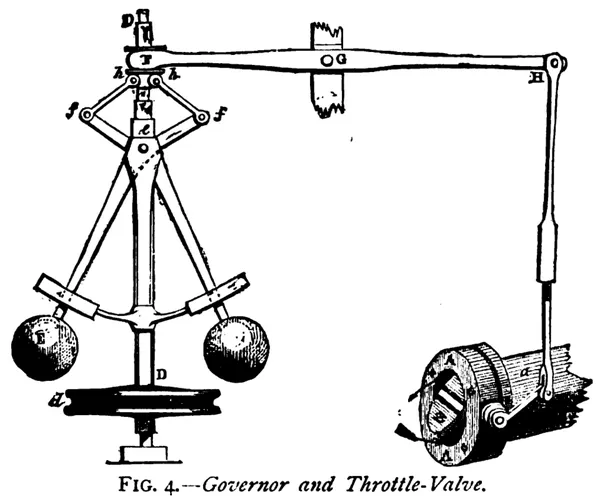
A centrifugal governor is a specific type of governor with a feedback system that controls the speed of an engine by regulating the flow of fuel or working fluid, so as to maintain a near-constant speed. It uses the principle of proportional control. A centrifugal governor was invented by Christiaan Huygens in the seventeenth century, where it was used "for the regulation of windmills and water wheels". The devices are also known as "centrifugal regulators" and "fly-ball governors". In 1788, James Watt adapted one to control his steam engine, where it regulated the admission of steam into the engine's cylinders. This development proved so important that Watt is sometimes called the inventor. Centrifugal governors' widest use was on steam engines during the Steam Age in the 19th century. They are also found on stationary internal combustion engines, variously fueled turbines, and in some modern striking clocks. A simple governor does not maintain an exact speed but a speed range, since under increasing load the governor opens the throttle as the speed (RPM) decreases.
Also on this shelf
GE B23-7.
Eugène Farcot.
See also
Uncatalogued shelfText from Wikipedia; plate via Wikimedia Commons. Text CC BY-SA 4.0; plate freely licensed (see Commons). Source record. Images and catalogue data are reproduced from open-access collections.