Invention and Engineering
Computer mouse
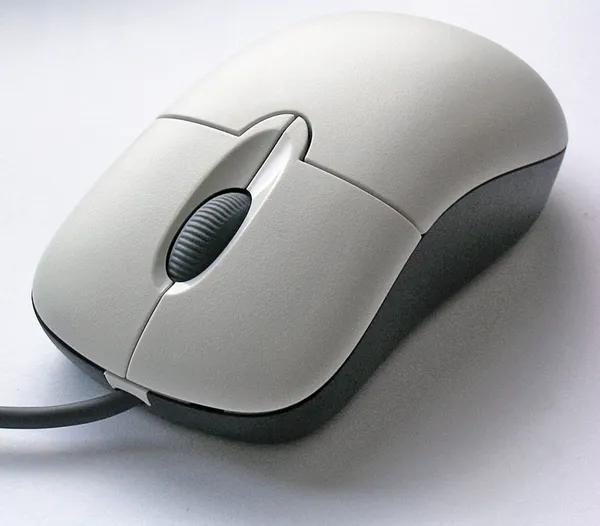
A computer mouse (plural mice; rarely mouses) is a hand-held pointing device that detects two-dimensional motion relative to a surface. This motion is typically translated into the motion of the pointer (called a cursor) on a display, which allows a smooth control of the graphical user interface of a computer. The first public demonstration of a mouse controlling a computer system was done by Douglas Engelbart in 1968 as part of The Mother of All Demos. Mice originally used two separate wheels to directly track movement across a surface in each dimension. Later, the standard design shifted to use a ball rolling on a surface to detect motion, in turn connected to internal rollers. Most modern mice use optical movement detection with no moving parts. Though originally all mice were connected to a computer by a cable, many modern mice are cordless, relying on short-range radio communication with the connected system. In addition to moving a cursor, computer mice have one or more buttons to allow operations such as the selection of a menu item on the associated display. Mice often also feature other elements, such as touch surfaces and scroll wheels, which enable additional control and dimensional input.
Also on this shelf
4-8-0+0-8-4.
Cambrian Railways 4-4-0 locomotives.
See also
Uncatalogued shelfText from Wikipedia; plate via Wikimedia Commons. Text CC BY-SA 4.0; plate freely licensed (see Commons). Source record. Images and catalogue data are reproduced from open-access collections.