Geology and Minerals
Great Sydney Dyke
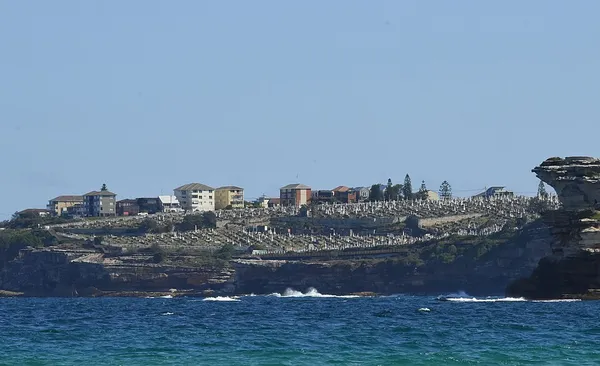
The Great Sydney Dyke is a major igneous dyke extending beneath the eastern and central parts of Sydney, New South Wales, Australia. Also historically designated Pittman Dyke LVI, it consists principally of dolerite and basalt intruded through the Triassic sedimentary rocks of the Sydney Basin, particularly the Hawkesbury Sandstone. The dyke extends approximately west-northwest to east-southeast from at least Glebe Island through Pyrmont, Ultimo, Haymarket, Surry Hills and Moore Park towards the coast near Waverley Cemetery. Its known onshore extent is at least 9 kilometres (5.6 mi), with a possible continuation towards Rozelle increasing this to about 10 kilometres (6.2 mi); its eastern termination lies offshore and has not been established. Potassium–argon dating of plagioclase from the dyke has yielded an age of 163.0 ± 3.3 million years, placing its emplacement in the Middle Jurassic. It is therefore substantially older than the opening of the Tasman Sea and the principal phase of separation between Australia and Zealandia. The dyke has also provided an important chronological marker for determining the age of later faulting in Sydney, as north-northeast-trending faults at Haymarket cut and displace it. Much of the Great Sydney Dyke is concealed beneath urban development, superficial deposits and reclaimed land, and knowledge of its course has consequently been assembled from historical exposures, boreholes, railway and road excavations, tunnels and other geotechnical investigations. It has particular significance in Sydney's engineering geology because the dolerite commonly weathers deeply to clay and is accompanied by fractured, sheared and locally metamorphosed sandstone. The dyke has therefore been encountered during numerous major infrastructure projects, including railway works, road construction, the Glebe Island Bridge, the Eastern Distributor and more recent tunnelling projects.
Also on this shelf
Ardennes.
Coal mines and saltworks of Gouhenans.
See also
Uncatalogued shelfText from Wikipedia; plate via Wikimedia Commons. Text CC BY-SA 4.0; plate freely licensed (see Commons). Source record. Images and catalogue data are reproduced from open-access collections.