Geology and Minerals
Cyanobacteria
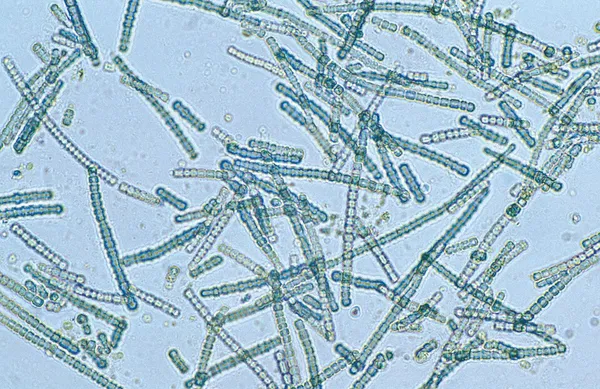
Cyanobacteria ( sy-AN-oh-bak-TEER-ee-ə) are a group of autotrophic gram-negative bacteria of the phylum Cyanobacteriota that can obtain biological energy via oxygenic photosynthesis. Cyanobacteria originated in a freshwater or terrestrial environment, and first appeared in the middle Archean eon. They are probably the most numerous taxon to have ever existed on Earth. The name "cyanobacteria" (from Ancient Greek κύανος (kúanos) 'blue') refers to their bluish green (cyan) color, which forms the basis of cyanobacteria's informal common name, blue-green algae. Cyanobacteria are the first organisms known to have produced oxygen. Their photopigments can absorb the red- and blue-spectrum frequencies of sunlight (thus reflecting a greenish color) to split water molecules into hydrogen ions and oxygen. The hydrogen ions are used to react with carbon dioxide to produce complex organic compounds such as carbohydrates (a process known as carbon fixation), and the oxygen is released as a byproduct. By continuously producing and releasing oxygen over billions of years, cyanobacteria are thought to have converted the early Earth's anoxic, weakly reducing prebiotic atmosphere, into an oxidizing one with free gaseous oxygen (which previously would have been immediately removed by various surface reductants), resulting in the Great Oxidation Event and the "rusting of the Earth" during the early Proterozoic, dramatically changing the composition of life forms on Earth. The subsequent adaptation of early single-celled organisms to survive in oxygenous environments likely led to endosymbiosis between anaerobes and aerobes, and hence the evolution of eukaryotes during the Paleoproterozoic. Cyanobacteria use photosynthetic pigments such as various forms of chlorophyll, carotenoids and phycobilins to convert the photonic energy in sunlight to chemical energy. Unlike heterotrophic prokaryotes, cyanobacteria have internal membranes. These are flattened sacs called thylakoids where photosynthesis is performed. Photoautotrophic eukaryotes such as red algae, green algae and plants perform photosynthesis in chlorophyllic organelles that are thought to have their ancestry in cyanobacteria, acquired long ago via endosymbiosis.
Also on this shelf
Archean life in the Barberton Greenstone Belt.
Gateway of India.
See also
Uncatalogued shelfText from Wikipedia; plate via Wikimedia Commons. Text CC BY-SA 4.0; plate freely licensed (see Commons). Source record. Images and catalogue data are reproduced from open-access collections.