Geology and Minerals
Ashfield Shale
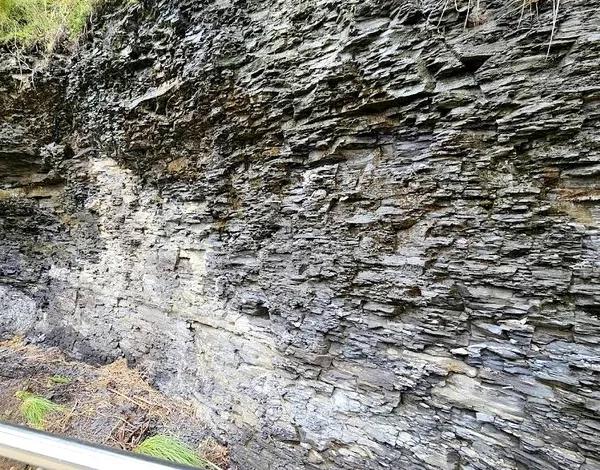
Ashfield Shale is a shale formation that is part of the Wianamatta Group of sedimentary rocks in the Sydney Basin, and it lies directly on contemporaneously eroded Hawkesbury sandstone or the Mittagong formation. These rocks were formed in the Triassic Period. Ashfield Shale is generally a dark, nearly black, clay-mineral-rich rock that should be distinguished from Bringelly Shale. Ashfield Shale has outcrops over many parts of the Greater Sydney area. Many structures and deep excavations were constructed on Ashfield Shale, in addition to the shale being used as a construction material. Fossils found from the Ashfield Shale indicate freshwater lake environments existed at different eras and places. Named after the Sydney suburb of Ashfield, some of the early research was performed at the old Ashfield Brickworks Quarry. This rock type is often associated with the Inner West and North Shore of the city. However, it has also been recorded at Penrith, Revesby, Bilpin and Mount Irvine. Ashfield Shale comprises black mudstones and grey shales with frequent sideritic clay ironstone bands. The thickness ranges between 45–64 metres (148–210 ft) and has been subdivided into four members that comprise shifting layers of dark-coloured ferruginous shale and laminite. Ashfield Shale is associated with the critically endangered Blue Gum High Forest and Sydney Turpentine-Ironbark Forest.
Also on this shelf
Bend Arch–Fort Worth Basin.
Alkali feldspar granite.
See also
Uncatalogued shelfText from Wikipedia; plate via Wikimedia Commons. Text CC BY-SA 4.0; plate freely licensed (see Commons). Source record. Images and catalogue data are reproduced from open-access collections.