Geology and Minerals
Coralline algae
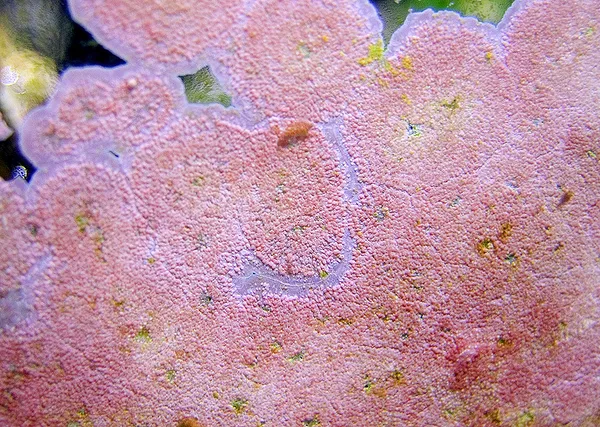
Coralline algae are red algae in the order Corallinales, characterized by a thallus containing calcareous deposits within its cell walls, giving it hardness. The colors of these algae are typically some hue of pink, or another shade of red, but some species can be purple, yellow, blue, white, or gray-green. Typically, these algae grow in a crustose manner (encrusting rocks and other hardscape); in the intertidal zone of rocky shorelines, and within coral reefs, these algae appear as an abundance of colorful patches on rock surfaces. Unattached specimens (maerl, rhodoliths) may form relatively smooth compact balls, and use underwater photosynthesis to get food or forming warty to fruticose thalli. The red algae belong to the division Rhodophyta, within which the coralline algae form the order Corallinales. There are over 1600 described species of nongeniculate coralline algae. The corallines are presently grouped into two families on the basis of their reproductive structures. Most are marine, though one species lives in freshwater; Pneophyllum cetinaensis. Coralline algae play an important role in the ecology of coral reefs. Sea urchins, parrot fish, along with limpets and chitons (both mollusks) feed on coralline algae. In the temperate Mediterranean Sea, coralline algae are the main builders of a typical algal reef, the Coralligène ("coralligenous").
Also on this shelf
Endorheic basin.
Ashe Metamorphic Suite.
See also
Uncatalogued shelfText from Wikipedia; plate via Wikimedia Commons. Text CC BY-SA 4.0; plate freely licensed (see Commons). Source record. Images and catalogue data are reproduced from open-access collections.