Geology and Minerals
946 eruption of Mount Paektu
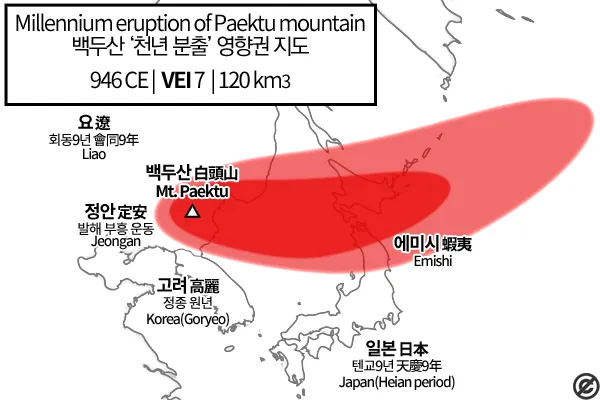
The 946 AD eruption of Mount Paektu, a stratovolcano on the border of North Korea and China also known as Changbaishan, occurred in late 946 AD. This event is known as the Millennium Eruption or Tianchi eruption. It is one of the most powerful volcanic eruptions in recorded history; classified at the most conservative estimate as a VEI 6, and in others, as a VEI 7. The eruption ejected about 13–47 cubic kilometres of magma (dense rock equivalent) and formed a caldera, which now contains a lake (Heaven Lake). The eruption had two phases that each included a Plinian fallout and a pyroclastic flow and erupted magmas that were different in composition. An average of 5 cm (2.0 in) of Plinian ashfall and co–ignimbrite ashfall covered about 1,500,000 km2 (580,000 sq mi) of the Sea of Japan and northern Japan. This ash layer has been named the "Baegdusan-Tomakomai ash" (B-Tm) and is valuable marker horizon for correlating regional sedimentary archives in and around the Sea of Japan. The Millennium Eruption was one of the largest and most powerful eruptions in the last 5,000 years, along with the Minoan eruption of Thera, the Hatepe eruption of Lake Taupō (around 230 AD), the 431 AD eruption of Lake Ilopango, the 1257 eruption of Mount Samalas near Mount Rinjani, and the 1815 eruption of Mount Tambora.
Also on this shelf
Boxwork.
Grand Erg Occidental.
See also
Uncatalogued shelfText from Wikipedia; plate via Wikimedia Commons. Text CC BY-SA 4.0; plate freely licensed (see Commons). Source record. Images and catalogue data are reproduced from open-access collections.