Geology and Minerals
Durupınar site
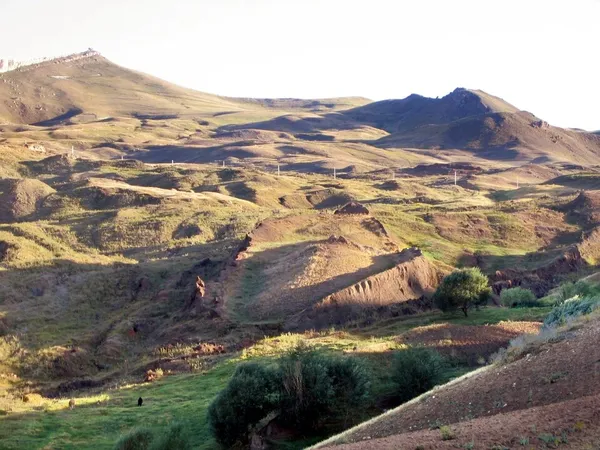
The Durupınar site (Turkish: Durupınar sitesi) is a geological formation 164 metres (538 feet) long, made of limonite on Mount Tendürek in eastern Anatolia or Turkey. The size and shape of the formation led to its promotion by some believers as the petrified ruins of the original Noah's Ark. Adjacent to the village of Üzengili, the site is 3 kilometres (1.9 miles) north of the Iran-Turkey border, 16 kilometres (9.9 mi) southeast of Doğubayazıt in the Ağrı Province, and 29 km (18 mi) south of the Greater Mount Ararat summit, at an elevation of 1,966 to 2,004 m (6,450 to 6,575 ft) above sea level. Geologists Lorence G. Collins (an anti-Creationist) and Andrew Snelling (a Young Earth Creationist) assert that it is an entirely natural formation, but have nominated it as (geological) heritage. This conclusion was corroborated by Dr. Eşref Atabey, a Turkish geological engineer and medical geologist of the General Directorate of Mineral Research and Exploration. The site is near several officially unnamed peaks, though locals call one of the nearby peaks Cudi Dağı in Turkish, which salvage expert David Fasold linked to Al Cudi, the place named in the Quran as the final resting place of Noah's Ark.
Also on this shelf
Geography of Taiwan.
High Valley AVA.
See also
Uncatalogued shelfText from Wikipedia; plate via Wikimedia Commons. Text CC BY-SA 4.0; plate freely licensed (see Commons). Source record. Images and catalogue data are reproduced from open-access collections.