Geology and Minerals
Deep biosphere
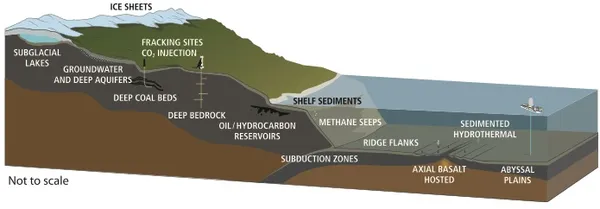
The deep biosphere is the part of the biosphere that resides below the first few meters of the land surface and seafloor. It extends 10 km (6.2 mi) below the continental surface and 21 km (13 mi) below the sea surface, at temperatures that may reach beyond 120 °C (248 °F) which is comparable to the maximum temperature where a metabolically active organism has been found. It includes all three domains of life and the genetic diversity rivals that on the surface. The first indications of deep life came from studies of oil fields in the 1920s, but it was not certain that the organisms were indigenous until methods were developed in the 1980s to prevent contamination from the surface. Samples are now collected in deep mines and scientific drilling programs in the ocean and on land. Deep observatories have been established for more extended studies. Near the surface, living organisms primarily consume organic matter and breathe oxygen (heterotrophs) or photosynthesize energy from sunlight (autotrophs). Lower down, these resources are not available, so organisms make use of "edibles" (electron donors) such as hydrogen (released from rocks by various chemical processes), methane (CH4), reduced sulfur compounds, and ammonium (NH4). They "breathe" electron acceptors such as nitrates and nitrites, manganese and iron oxides, oxidized sulfur compounds and carbon dioxide (CO2). There is very little energy at greater depths, so metabolisms are up to a million times slower than at the surface. Cells may live for thousands of years before dividing and there is no known limit to their age. The subsurface accounts for about 90% of the biomass across two domains of life, Archaea and Bacteria, and approximately 15% of the Earth's total biosphere. Estimates of the exact mass vary significantly depending on the samples and measurement methods used, but the "15 to 23 billion tons" figure is cited very often. Eukarya are also found, including some multicellular life - fungi and animals (nematodes, flatworms, rotifers, annelids, and arthropods). Viruses are also present and infect the microbes.
Also on this shelf
Kanaga Volcano.
Euhedral and anhedral.
See also
Uncatalogued shelfText from Wikipedia; plate via Wikimedia Commons. Text CC BY-SA 4.0; plate freely licensed (see Commons). Source record. Images and catalogue data are reproduced from open-access collections.