Geology and Minerals
Glacier Bay National Park and Preserve
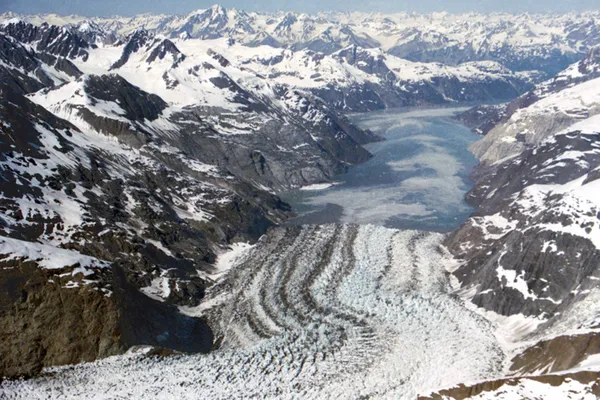
Glacier Bay National Park and Preserve is a national park of the United States located in Southeast Alaska west of Juneau. President Calvin Coolidge proclaimed the area around Glacier Bay a national monument under the Antiquities Act on February 26, 1925. Subsequent to an expansion of the monument by President Jimmy Carter in 1978, the Alaska National Interest Lands Conservation Act (ANILCA) enlarged the national monument by 523,000 acres (817.2 sq mi; 2,116.5 km2) on December 2, 1980, and created Glacier Bay National Park and Preserve. The national preserve encompasses 58,406 acres (91.3 sq mi; 236.4 km2) of public land to the immediate northwest of the park, protecting a portion of the Alsek River with its fish and wildlife habitats, while allowing sport hunting. Glacier Bay became part of a binational UNESCO World Heritage Site in 1979, and was inscribed as a Biosphere Reserve in 1986. The National Park Service undertook an obligation to work with Hoonah and Yakutat Tlingit Native American organizations in the management of the protected area in 1994. The park and preserve cover a total of 3,223,384 acres (5,037 sq mi; 13,045 km2), with 2,770,000 acres (4,328 sq mi; 11,210 km2) being designated as a wilderness area.
Also on this shelf
Euhedral and anhedral.
Geology of East Sussex.
See also
Uncatalogued shelfText from Wikipedia; plate via Wikimedia Commons. Text CC BY-SA 4.0; plate freely licensed (see Commons). Source record. Images and catalogue data are reproduced from open-access collections.