Geology and Minerals
Carbonate–silicate cycle
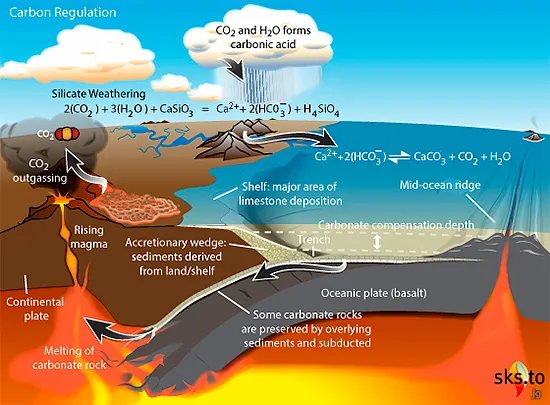
The carbonate–silicate geochemical cycle, also known as the inorganic carbon cycle, describes the long-term transformation of silicate rocks to carbonate rocks by weathering and sedimentation, and the transformation of carbonate rocks back into silicate rocks by metamorphism and volcanism. Carbon dioxide is removed from the atmosphere during burial of weathered minerals and returned to the atmosphere through volcanism. On million-year time scales, the carbonate-silicate cycle is a key factor in controlling Earth's climate because it regulates carbon dioxide levels and therefore global temperature. The rate of weathering is sensitive to factors that change how much land is exposed. These factors include sea level, topography, lithology, and vegetation changes. Furthermore, these geomorphic and chemical changes have worked in tandem with solar forcing, whether due to orbital changes or stellar evolution, to determine the global surface temperature. Additionally, the carbonate-silicate cycle has been considered a possible solution to the faint young Sun paradox.
Also on this shelf
Armero tragedy.
Carbon cycle.
See also
Uncatalogued shelfText from Wikipedia; plate via Wikimedia Commons. Text CC BY-SA 4.0; plate freely licensed (see Commons). Source record. Images and catalogue data are reproduced from open-access collections.